
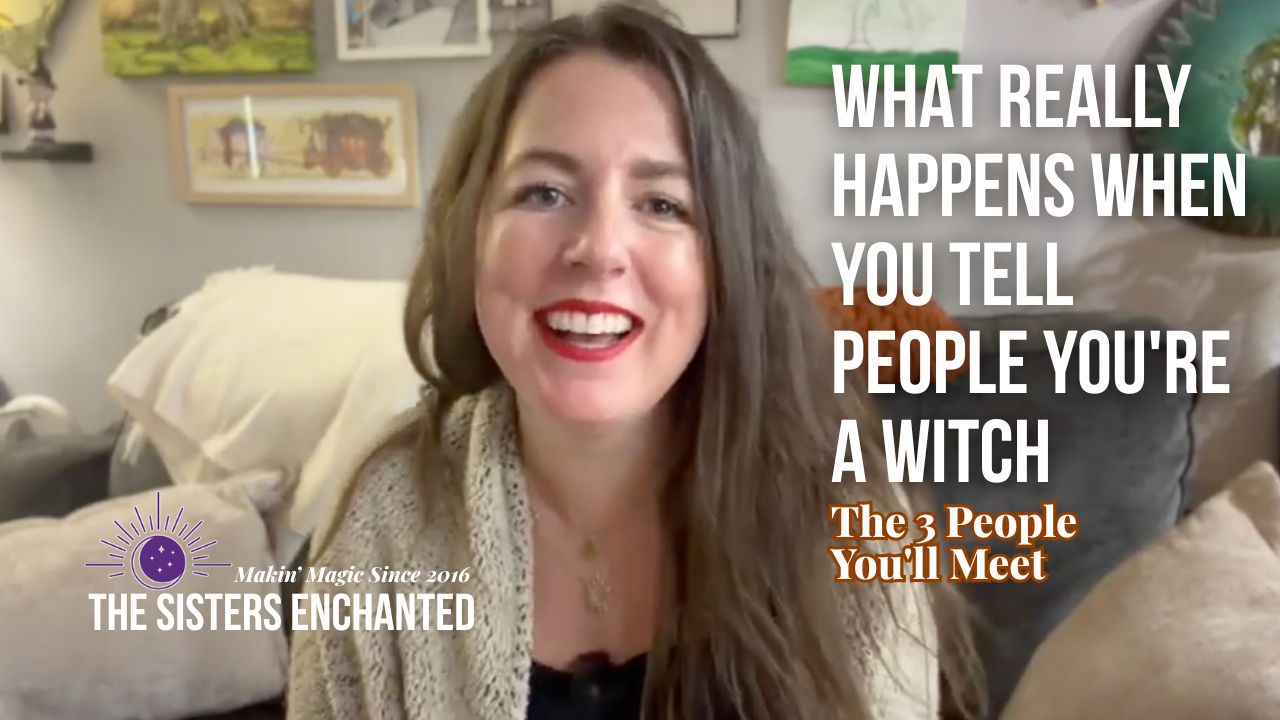
TLDR
- The moment you tell people you're a witch (or even just that you read tarot), they sort themselves into one of three reactions. Knowing which is which saves you a lot of heartache.
- Naysayers will judge you and argue with you no matter what you say, because no answer was ever going to satisfy them. The move is to disengage, not to convince.
- Neutrals are the biggest group by far. They acknowledge what you do and move on, no judgment. Neutrality runs both ways, and that mutual live-and-let-live is what lets very different people stay close.
- New BFFs come out of the woodwork in the most unexpected places. Sometimes they relate to it more casually than you do, but meeting their excitement with an open door is how a real friendship starts.
- If no one in your life is into witchy things, that's okay. The people you already have don't have to check every box, and the internet can hand you the community you've been missing.
Hi, I’m Sara Walka, founder of The Sisters Enchanted. I’ve been a witch my whole life (and my mom would happily back me up on that one). I bought my first tarot deck at 15, started this brand in 2016, and over 300,000 people have moved through our free learning since. I’ve been reading tarot for 24 years now. I’m telling you all of that up front because I’ve spent more than a decade being a witch out loud on the internet, and in that time I’ve heard from thousands of women about what actually happens when they start telling the people in their lives who they really are. So this isn’t theory for me. It’s lived, mine and theirs both.
Here’s something nobody really warns you about. The minute you say the word witch out loud, or even just mention that you read tarot cards, people start sorting themselves into camps. You can almost watch it happen in real time. And after 10 years of doing this work, plus hearing from women all over the internet, I can tell you there are three kinds of people you’re going to meet on this journey. Let’s talk about all three.
Why does saying you read tarot get a bigger reaction than astrology?
Astrology gets a pass that tarot doesn’t, and I think it comes down to familiarity. Horoscopes have lived in newspapers and magazines for decades, so the average person has a comfortable, low-stakes relationship with the idea of star signs. Tarot doesn’t have that same cultural cushion, and neither does the word witch. So when you start using those words to describe yourself, you’re stepping outside what most people have been trained to find normal, and that’s exactly when the eyebrows go up. (For the record, your sun sign horoscope isn’t even the one you should be reading, but that’s a whole other conversation for another day.)
So who are these three kinds of people?
Over 10 years of running The Sisters Enchanted, plus my own life as a witch married into a very religious family, I’ve watched the same three types show up again and again. We bring a lot of women into our community who don’t “look like” witches, who have zero interest in memorizing every card, who pull tarot at a new moon or a full moon and leave it at that. They’re bringing the flavor of witchery into their lives rather than making it the whole meal.
“Instead of witchery being the whole seven-course meal, it’s the seasoning on top.”
— Sara Walka, Founder of The Sisters Enchanted
And no matter where a woman lands on that spectrum, the people around her tend to react in one of three ways. Let’s meet them.
The naysayers: the people who will never be on your side
These are the folks who are going to be unkind about it, even if they’d never describe themselves that way. Their reaction won’t be love-filled. They’ll cast judgment, they’ll try to talk you out of what you’re doing, and they’ll ask you questions that don’t actually have a satisfying answer, because no answer was ever going to satisfy them. That’s the whole thing about a naysayer. You could explain yourself perfectly and they’d still find something to push back on, because pushing back is the point for them. They are actively, vocally against your new practices, your new people, your new curiosities, your new way of being. Nothing you say matters.
DEFINITION: THE NAYSAYER
A person who responds to your spiritual path with active disapproval. They cast judgment, try to talk you out of it, and ask questions that have no satisfying answer because they aren’t actually looking for one. No response you give will please them. The move with a naysayer is never to convince them. It’s to disengage and protect your energy.
Source: Sara Walka, Founder of The Sisters Enchanted
“It’s like social media comments in real life. Do not engage.”
— Sara Walka, Founder of The Sisters Enchanted
So my advice with naysayers is simple: in one ear, out the other. You already know exactly who these people are in your life. You’re not going to win them over, and trying will only drain the energy you could be spending on the people who actually meet you where you are.
The neutrals: most people, and probably you too
This is the biggest group by far. Neutrals aren’t going to argue with you, but they’re also not going to ask follow-up questions or make any kind of big deal out of it. They’ll say “okay” and move right along. When I look around my own life, most of the people in it are neutral toward what I do, and that includes a very religious family. I was raised going to a congregational church, the kind of place that honestly might’ve had a tarot reader at a youth event. My family members will hand me a Bible when they spot my cards. Recently one of them gifted my kids little mini Bible keychains, and I couldn’t help but wonder what made them think that’s what we were after. But here’s the thing: they never speak ill of what I do, what I teach my children, or who I am. They’re neutral. And I’m neutral right back. I don’t raise my hand at the holiday table during the family prayer to share my thoughts on it. You live your life, I’ll live mine, we love each other, and it’s all well and good.
DEFINITION: THE NEUTRAL
The most common reaction by far. A neutral person neither supports nor opposes your practice. They acknowledge it and move on, without follow-up questions and without judgment. Neutrality usually runs both ways (you’re probably neutral toward some of their beliefs too), and that mutual live-and-let-live is exactly what lets very different people stay close.
Source: Sara Walka, Founder of The Sisters Enchanted
“You can belong in your friend group and your family, and be loved and love, without being the same people. That’s the beauty of humanity.”
— Sara Walka, Founder of The Sisters Enchanted
Neutrality runs in both directions, and that’s genuinely a gift. You don’t need every single person in your life to share your worldview in order to belong with them.
Your new BFFs: the friends you didn’t know you were looking for
And then there are the people who come out of the woodwork. You mention tarot, you mention your witchy things, and suddenly someone lights right up: “Oh, I love that, will you read for me? I’m so witchy too.” These are your new BFFs, and they show up in the most unexpected places. Now, one honest heads-up. Sometimes a new BFF will talk about all of this in a lighter, more casual way than you’re experiencing it, and that can sting a little. You might think, that’s not quite what I mean by this. I’d invite you to let that feeling come up and then look at it generously, because there’s a good chance that casual, hobby-level version is the only way this person has ever encountered witchery. Maybe all they’ve got is an eye-rolling story about Aunt Margie the witchy one, or the movie Practical Magic (which, for the record, I love 100 percent). If they’ve never met someone for whom this is a way of being rather than a hobby, the light version might be the only language they have.
So instead of shutting the door, crack it open. You don’t have to promise them a reading. You can simply say, “If you ever want to talk tarot, I’d love to.” That’s often where a real friendship starts.
DEFINITION: THE NEW BFF
Someone who responds to your witchy self with genuine enthusiasm and wants in. They often appear from the most unexpected corners of your life. They may relate to the work more casually than you do, which can feel like a mismatch, but it’s usually just the only frame of reference they have. Meeting their excitement with an open door, rather than a correction, is how a new BFF becomes a real one.
Source: Sara Walka, Founder of The Sisters Enchanted
“You never know where you’re going to find that friend that you didn’t know you were looking for.”
— Sara Walka, Founder of The Sisters Enchanted
I’ve met some of my favorite people exactly this way. As a homeschooling mom of two, I meet a lot of other moms, and plenty of them are squarely in the neutral camp. But every so often one of them hears what I do and says, “I wish I’d known someone like you years ago.” Those are the ones. There are far more interested people out there than you’d think, they just don’t have the words for it yet, and they don’t know anyone like you to talk to about it. Opening that door can turn into a really beautiful conversation.
What if no one in your life is into witchy things?
If you look around and don’t spot a single new BFF in the bunch, please hear me on this: the people already in your life don’t have to check every box for you. You’re allowed to go find the rest of your people elsewhere. Metaphysical shops, wellness spaces, and online communities (including ours here at The Sisters Enchanted) are full of women who’ll meet you exactly where you are. Honestly, the witches closest to me are people I met online. They live all over the country, and we text and chat and visit, and it’s one of the great blessings of my life. If you live in the Bible Belt, or anywhere a full moon circle isn’t exactly around the corner, the internet can crack your world wide open. You are not nearly as alone in this as it can feel.
So those are your three: the naysayers you let roll right off you, the neutrals you love without needing to match, and the new BFFs who turn up where you least expect them. I hope you find yours. Stay magic, Enchanted Sister.
Frequently Asked Questions
Common questions about telling people you’re a witch, answered.
What happens when you tell people you’re a witch?
When you tell people you’re a witch, they tend to sort into one of three reactions. According to Sara Walka, founder of The Sisters Enchanted, after more than a decade of being publicly witchy and hearing from thousands of women, the three types are naysayers (who actively disapprove and won’t be won over), neutrals (the largest group, who acknowledge it and move on without judgment), and new BFFs (who light up with genuine interest and want to connect). Knowing which type you’re dealing with helps you respond well: don’t waste energy convincing the naysayers, extend the same neutrality back to neutral friends and family, and keep an open door for the new BFFs, who often appear from unexpected places.
Why do people react more strongly to tarot than to astrology?
People react more strongly to tarot than to astrology largely because of familiarity. Sara Walka of The Sisters Enchanted points out that horoscopes have appeared in newspapers and magazines for decades, giving most people a comfortable, low-stakes relationship with star signs. Tarot, and especially the word witch, doesn’t carry that same cultural familiarity, so using those words to describe yourself can feel to others like stepping outside the norm. The stronger reaction usually isn’t about tarot itself. It’s about how unfamiliar it still is to the average person.
How do you deal with people who judge you for being a witch?
The most effective way to deal with people who judge you for being a witch (the naysayers) is to disengage rather than try to convince them. Sara Walka, founder of The Sisters Enchanted, describes naysayers as people who will find fault no matter how well you explain yourself, because their disapproval isn’t really a question waiting to be answered. She compares engaging with them to arguing in the comments section, except in real life. The healthier approach is to let their reactions roll off you, in one ear and out the other, and to put your energy toward the people who can actually meet you.
What if my family is religious and doesn’t approve of my spiritual practice?
If your family is religious, approval and disapproval aren’t the only options. Neutrality is often the most peaceful path, and it can run both ways. Sara Walka of The Sisters Enchanted comes from a very religious family and describes a neutral coexistence: her relatives may hand her a Bible or gift her children Bible keychains, but they don’t speak ill of what she does or who she is, and she extends the same respect to their beliefs in return. You can belong with people and love them deeply without sharing their worldview. That mutual live-and-let-live is what allows very different people to stay close.
How do I find witchy friends if no one in my life is into it?
If no one in your current life shares your spiritual interests, you can find your people in metaphysical shops, wellness spaces, and online communities. Sara Walka, founder of The Sisters Enchanted, notes that the witches closest to her are people she met online who live all over the country, and that the internet can be especially valuable if you live somewhere, like the Bible Belt, where in-person witchy community is hard to find. The people already in your life don’t have to meet every need. It’s completely valid to build the rest of your circle elsewhere.
Is it normal to feel disappointed when someone treats witchcraft like a casual hobby?
Yes, it’s completely normal to feel a small letdown when someone treats your spiritual life as a casual hobby, and there’s a generous way to read it. Sara Walka of The Sisters Enchanted suggests that when an enthusiastic “new BFF” relates to witchery more lightly than you do, it’s often because a hobby-level version is the only way they’ve ever encountered it. Rather than correcting them or closing the door, she recommends meeting their excitement with a simple open invitation, like offering to talk tarot sometime. That openness is frequently where a surface-level connection grows into a real friendship.