
TLDR
- The witch wound is the deep, conditioned fear of being seen and rejected, and it’s why so many witchy women care so much about what other people think.
- Intentional invisibility is the number one witch wound pattern: hiding your magic, downplaying yourself, and apologizing before you’ve done anything wrong.
- Overthinking your texts, replaying conversations at night, and checking if someone’s mad at you are all the witch wound at work.
- Caring what people think isn’t selfish to let go of; it’s your energy getting siphoned onto things that don’t matter.
- You can’t heal what you can’t see, so the first step is naming the witch wound for what it is.
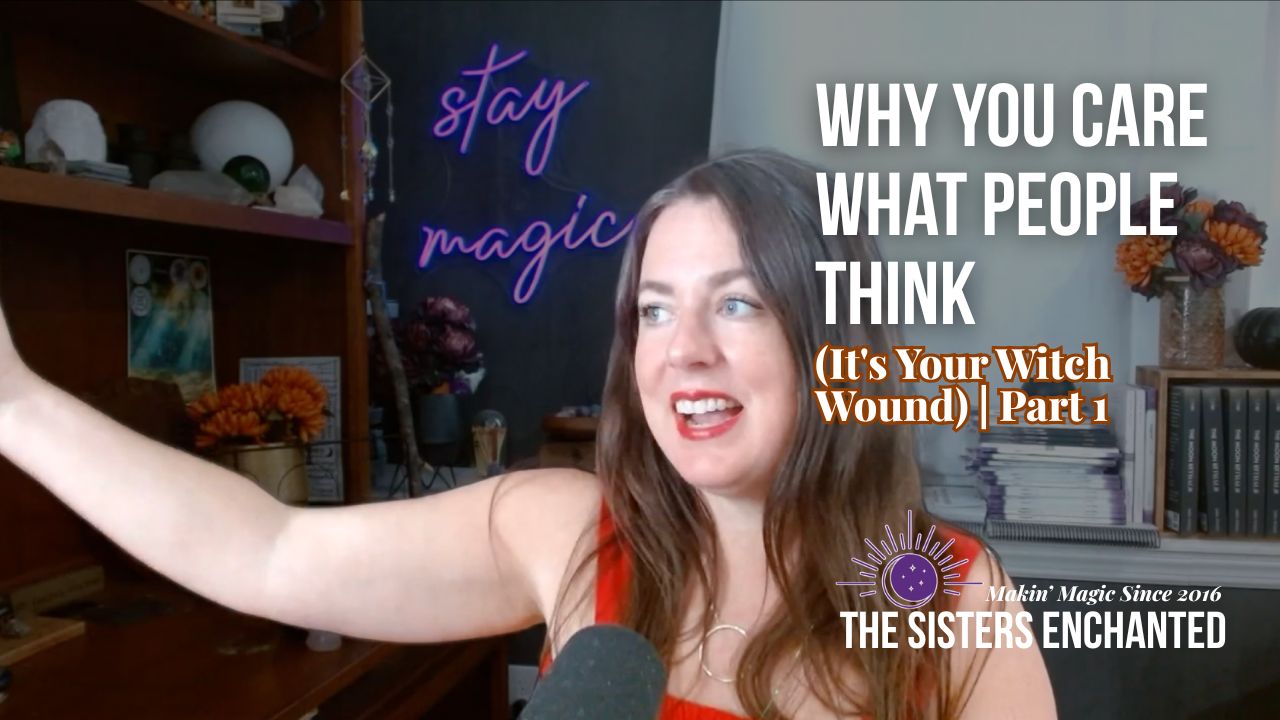
Here’s the thing about caring what other people think: it’s one of the most human things we do, and it’s also one of the most exhausting. I’m Sara Walka, founder of The Sisters Enchanted, and since 2016 I’ve been helping witchy women combat what I call the witch wound. And the women in our Holistic Witchery program and our Enchanted Journey membership tell me the same thing on repeat: they’re tired of overthinking every message they send. They want to stop spiraling when someone doesn’t text back right away. They want to be able to say no, or disappoint someone, or just not respond fast enough, without their whole nervous system going into alarm.
That’s the witch wound in action. And today we’re digging into one specific shape it takes: caring what other people think, and the quiet, intentional invisibility that comes with it. (This is part one of a two-part series, so if you’re reading from the future, you might already have part two waiting for you too.)
DEFINITION: THE WITCH WOUND
The witch wound is the conditioned fear of being seen and rejected for who you truly are. It comes from centuries of societal conditioning, placed primarily on women, that taught us being visible, powerful, or “too much” is dangerous. To stay safe, we keep ourselves small.
What is the witch wound, and why does it make you care so much what people think?
The witch wound is the deep fear of being seen and rejected for who you really are, and it’s the reason so many of us shrink, soften, and disappear before anyone gets the chance to turn away from us. When you’re afraid of being witnessed as you are, caring what people think stops being a casual social skill and starts running the whole show.
I’ve been doing this work for ten years, and before this I worked with adults and children with learning differences. So I got to watch these patterns get embedded early. When you’re the kid who feels like an outlier, who sticks out, who has to ask more questions than everyone else, you learn to overcompensate. You get good. You get likable. You start collecting your worth and your value by doing more for other people. And then you grow up, and that survival strategy is still running, quietly keeping you safe and quietly keeping you invisible.
What is intentional invisibility?
Intentional invisibility is the number one witch wound pattern I see in our community. It’s the habit of downplaying your awesomeness, hiding your magic, dimming your own inner light, and apologizing before you’ve done a single thing that needs an apology. It’s one of seven witch wound patterns I’ve seen with the thousands of people who’ve come my way since 2016, and it’s the one women here tell us they feel the most.
It shows up in small, sneaky ways. You sidestep the awesome that you are. You don’t toot your own horn because you don’t want to seem braggy or like you’re not humble. And for so many people in our community, it looks like never telling a soul that they’re witchy, or witch-curious, or that they’d love to do a new moon ritual or pull tarot, because they’re scared of how it’ll land. The family doesn’t get it. There are misconceptions about what “witch” even means. So to stay safe from all of it, we dim our own light.
DEFINITION: INTENTIONAL INVISIBILITY
Intentional invisibility is the witch wound pattern of deliberately making yourself smaller to avoid being rejected. It’s the most common pattern reported inside The Sisters Enchanted, and it looks like downplaying your gifts, hiding your spiritual practice, and apologizing preemptively to stay safe in the in-group.
What intentional invisibility actually looks like
- Downplaying your awesomeness and your energy
- Hiding your magic and your inner light
- Apologizing before you have anything to apologize for
- Refusing to say good things about yourself so you don’t seem “too much”
- Hiding your spiritual practice from family or friends who might not understand
- Skipping the morning ceremony, the meditative walk, the art, the clothes you actually want to wear
“But to remain safe from those misconceptions, we dim our own light.”
— Sara Walka, Founder of The Sisters Enchanted
Why do you overthink every text and replay conversations at night?
Because when being seen feels dangerous, your brain starts treating every interaction like a test you might fail. So you overthink every single message before you send it. You find it almost impossible to wait for a reply, and the second there’s a gap between your message and their response, you decide you must have said or done something wrong.
This is why you replay conversations at night instead of going to sleep. This is why you end up on someone’s Instagram or Facebook trying to figure out if they’re still alive or just mad at you because they haven’t answered fast enough. (If you just laughed because you’ve done the 11pm profile check, hi, me too.) None of that is a character flaw. It’s a nervous system doing exactly what it learned to do: scan for rejection, and keep you safe by keeping you small.
Where does the witch wound actually come from?
It’s not a personal failing. It’s centuries of societal conditioning placed on women primarily (and men too) to keep us acting a certain way, talking a certain way, and being a certain way so we comply and fit the picture of what a “good woman” or a “good girl” is supposed to be. That conditioning is exactly why we deprioritize ourselves, our passion, our pleasure, and our energy in service of everybody else.
The word witch has history here. It’s been used to make people comply, to take resources from one group and hand power to another. Today it gets attached to anyone reading tarot, building rituals, working with the new moon, or working with energy, even though you don’t actually have to claim the word witch to do any of those things. And that’s exactly why I love the word, and why I love exploring the witch wound: because the overthinking, the shrinking, the hiding, all of it comes from that same old fear of rejection and getting it wrong.
“When you try to stay safe out of fear, that is very constricting. That is not an expansive energy.”
— Sara Walka, Founder of The Sisters Enchanted
Is it wrong to care what other people think?
No, and this is the part people get twisted. It’s not about deciding to just be you with total disregard for everyone around you. We care about our loved ones and how we show up for them, and that’s a good thing. The problem is the degree.
When you’re caring to the point of wondering whether what you said was the okay thing to say, whether how you dressed offended someone, whether you should text and check in just in case, that’s not connection anymore. That’s energy getting siphoned away from you, drop by drop, onto things that do not matter, so that you don’t have any energy left for the things that actually do. Here’s the difference: staying safe out of fear is constricting and closes possibilities down. Staying safe out of your own self-love and self-worth is expansive, and it opens them right back up.
How do you start to care less about what people think?
You start by seeing it. Every one of these patterns can be broken through some inner work, so you don’t need to worry too much about the witch wound holding you back forever. But first we have to name it for what it is, because you can’t heal what you can’t see.
So instead of pouring your energy into caring what other people think, you start caring more about healing the witch wound that put you in that position in the first place. That’s the real work, and it’s the work we do together inside The Sisters Enchanted. Your energy was never meant to be hidden.
“Your energy is born to radiate. You are born to radiate, my friend.”
— Sara Walka, Founder of The Sisters Enchanted
This is part one of a two-part series. In part two, we go deeper into how to actually loosen the grip of caring what other people think. If you want tools and resources to start working with your own witch wound, that’s exactly what we build inside the Enchanted Journey membership. Until next time, stay magic, Enchanted Sister.
Frequently Asked Questions
What is the witch wound?
The witch wound is the deep, conditioned fear of being seen and rejected for who you truly are. At The Sisters Enchanted, founder Sara Walka describes it as the result of centuries of societal conditioning, placed primarily on women, that taught us being visible, powerful, or “too much” is dangerous. To stay safe, we keep ourselves small, quiet, and agreeable. It shows up as overthinking, people-pleasing, and hiding the parts of ourselves we’re afraid won’t be accepted. The witch wound isn’t a personal flaw or a diagnosis. It’s a learned survival pattern, which is exactly why it can be unlearned through inner work once you can see it clearly.
What is intentional invisibility?
Intentional invisibility is the most common witch wound pattern reported inside The Sisters Enchanted community. It’s the habit of deliberately making yourself smaller to avoid being rejected: downplaying your gifts, hiding your magic, refusing to say good things about yourself, and apologizing before you’ve done anything wrong. It’s one of seven witch wound patterns Sara Walka has identified after working with thousands of women since 2016. For many people it also looks like hiding their spiritual practice entirely, never telling anyone they’re witchy or witch-curious because they’re afraid of how it will be received. The key word is intentional: it’s a choice your nervous system makes to keep you safe, often without you noticing.
Why do I overthink every message I send?
You overthink your messages because the witch wound has trained your nervous system to treat every interaction as a test you might fail. When being seen feels risky, your brain scans for rejection, so a delayed reply reads as proof you said something wrong. This is the same pattern behind replaying conversations at night and checking someone’s social media to see whether they’re upset with you. Sara Walka teaches that this isn’t a character flaw; it’s a protective response rooted in the fear of being rejected. The good news is that naming the pattern is the first step to loosening its grip, because you can’t heal what you can’t see.
Is caring what other people think always a bad thing?
No. Caring what other people think isn’t inherently bad, and healing the witch wound is not about disregarding the people you love. The problem is the degree. When caring tips into wondering whether what you said was okay, whether your outfit offended someone, or whether you should text just to check in, your energy is being siphoned onto things that don’t matter, leaving nothing for the things that do. Sara Walka frames the difference this way: staying safe out of fear is constricting and shuts possibilities down, while staying safe out of self-love and self-worth is expansive and opens them back up. The goal is connection without self-abandonment.
Do I have to call myself a witch to have a witch wound?
No. You don’t have to identify with the word witch to experience the witch wound, and you don’t have to claim it to read tarot, create rituals, work with the moon, or work with energy. Sara Walka notes that the word witch has historically been used to make people comply and to strip power from one group while handing it to another. The witch wound describes the conditioning that keeps people small out of fear of rejection, regardless of what they call themselves or whether they practice anything spiritual at all. If you recognize the overthinking and self-shrinking, the wound is relevant to you, label or no label.
How do I start healing the witch wound?
You start by seeing it. According to Sara Walka of The Sisters Enchanted, every witch wound pattern can be broken through inner work, but the first and non-negotiable step is naming the pattern for what it is, because you can’t heal what you can’t see. From there, the work shifts from pouring energy into what other people think toward healing the wound that created that habit in the first place. That’s the focus of TSE programs like Holistic Witchery and the Enchanted Journey membership, where this work is done in community rather than alone. Healing isn’t a single moment; it’s the ongoing practice of choosing expansive, self-loving safety over fear-based safety.