
TLDR, READ THIS FIRST
- Belonging is not something a community hands you. You belong because you allow yourself to belong, and that means letting yourself be seen.
- Witnessing and being witnessed is the core skill of real community: letting someone share something true (a win, a fear, a joy) and receiving it without making it mean anything about you.
- Most of us were taught the opposite. Be humble, don’t brag, deflect the compliment, don’t make anyone feel bad. That conditioning is exactly what keeps us lonely in a crowded room.
- Cliques and in-groups usually form out of fear, not cruelty. The fix is not gossip or blame, it’s raising the energy back up and leveling the field so everyone belongs.
- The more authentically you show up (yellow Jeep, flower crown, all black, whatever is true for you) the more you actually fit in, because fitting in was never the goal.
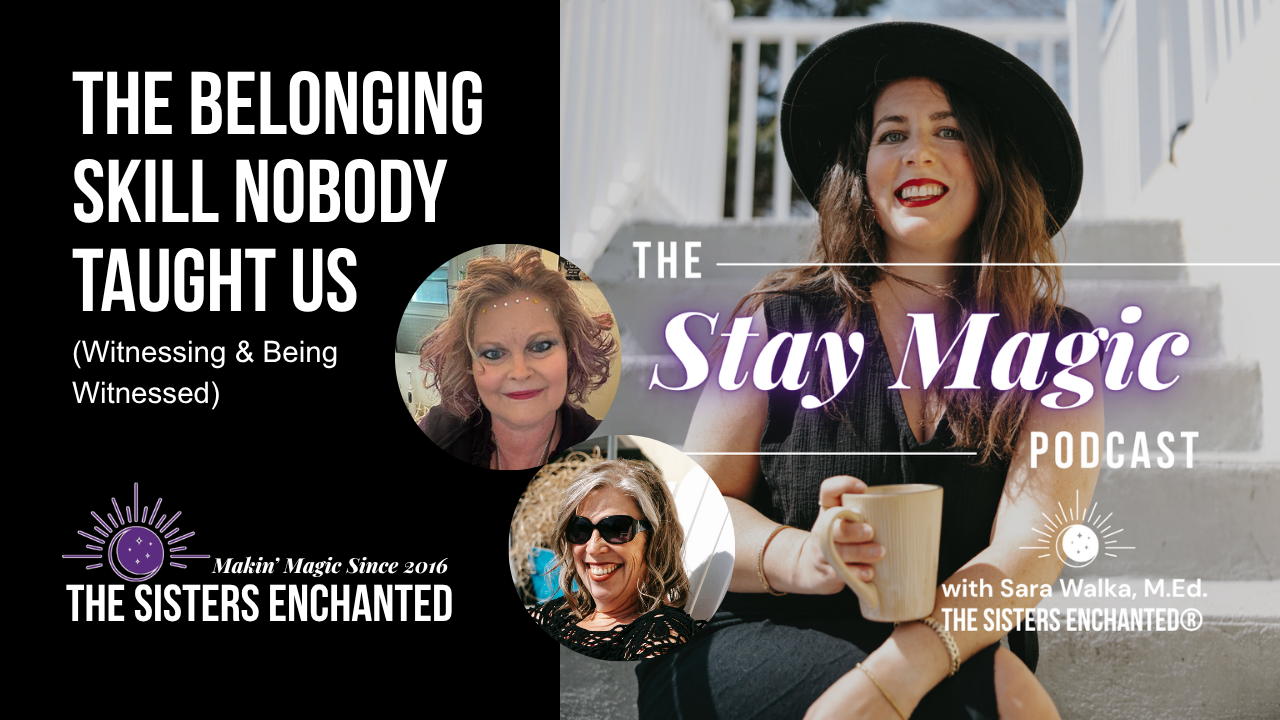
This one comes from our Salem 2026 gathering, with Jenn Reagan and Naomie Harris.
Hi, I’m Sara Walka, founder of The Sisters Enchanted, and I’ve spent the better part of a decade building community with witchy women. First online, and then, this year, in person in Salem, Massachusetts. Here’s something I’ve learned in all that time: a lot of us are really good at being in a room full of people and still feeling completely alone in it.
You know the feeling. You get invited to something new, maybe a group of women you’ve only ever met through a screen, and before you can even RSVP your whole body says no. Too much to manage. Too many other people’s emotions to carry. What if you say one true thing about yourself and somebody shuts down, and now you’re spending the whole night trying to figure out why they shut down? It’s a whole gosh darn thing, and most of us would honestly rather just stay home.
So I brought two of my favorite people onto the podcast to talk about it: Jenn Reagan and Naomie Harris, who together pulled off our first big in-person gathering. They saw all of it. The excited women, the nervous women, the ones emailing us beforehand practically begging to be talked out of coming. And what came out of that weekend is the thing I want to hand you today: the actual practice that turns a pile of strangers into people who belong to each other. It’s called witnessing and being witnessed, and nobody teaches it to us. So let’s fix that.
DEFINITION: WITNESSING AND BEING WITNESSED
Witnessing and being witnessed (a Sisters Enchanted approach to belonging) is the practice of letting another person share something true about their life, a win, a struggle, a fear, or a joy, and simply receiving it without letting it mean anything about you. Witnessing is hearing someone say “I just got a $20,000 raise” and being able to hold space for their good thing even when you’re the one struggling. Being witnessed is letting yourself be seen in your good thing or your hard thing, instead of shrinking it down so nobody else feels bad. In community, it’s the muscle that has to be strong for belonging to be real.
What does it really mean to belong in a community?
Belonging is not something a community grants you from the outside. You belong because you allow yourself to belong, and allowing it means letting yourself actually be seen. That’s the whole thing, and it’s harder than it sounds.
We throw the word community around a lot these days. You sign up for a program and there’s a community, which turns out to be a mildly moderated Facebook group people may or may not check into. That’s not it. Community is truly having people’s backs. It’s having a neighbor whose door you can knock on to say this thing happened, or I need this, can you help me. It is very challenging to build that in a digital space. I know, because I do it. But it’s doable, and it’s worth understanding what actually goes into holding it.
Think about a family, because a family is a community too. Y’all bicker, you’ve got wildly different opinions, and for the most part you still show up to the holiday dinner and it’s okay. Community is no different. Sometimes you work through the itchy stuff, and sometimes you just have to ask, what’s the north star that brings us all back together? Here’s what struck me about our women in Salem: the only thing every single one of them truly had in common was the witch hat they like to put on, sometimes in public and sometimes in private. Different ages, different stages, different bodies, different bank accounts, even different religions. And they still belonged, because they let themselves.
“We belong because we allow ourselves to belong.”
SARA WALKA · THE SISTERS ENCHANTED
Why do we say no to new spaces before we even try?
We say no because we’re afraid of being too much, and because we don’t want one more set of emotions to manage. That fear kicks in before we’ve even thought it through.
A lot of us are introverts, or extroverted introverts, or just deeply empathic, and there’s a part of us that quietly decides we don’t need whatever other women might bring to the table. We’re scared of sounding braggy. We’re scared of making someone feel bad. You say one nice thing about your own life, somebody else goes quiet, and now you’re managing that too. So it feels safer to opt out entirely.
When we opened the doors to Salem, the inbox told the whole story. We had women writing in who were very desperately trying to talk themselves out of coming, and coming up with some genuinely great reasons not to. Some truly couldn’t make it, completely understandable. But a lot of them were just scared. Scared of not being accepted. Scared of showing up and not finding one friendly face. Scared of being too loud, too witchy, not witchy enough, or of not being able to keep up. Naomie put it perfectly: everybody was going to be scared, so the real question was what could we do in advance to help them feel safe enough to come anyway.
Here’s the reframe that cracks it open, and it’s pure holistic witchery. Instead of asking how am I going to act around these new people, or bracing for how nervous you’ll be, ask: how do I want to feel instead? Jenn does this every single day. Before our recording she decided she wanted to feel confident and knowledgeable, so that’s how her day went. When you know how you want to feel, you can source the self-trust to walk through the door. If caring what everyone else might think is the thing keeping you home, I’ve written a whole lot more about that in the witch wound and caring what other people think series over on the blog.
What is witnessing and being witnessed (and why is it so hard)?
Witnessing is receiving someone’s truth without making it about you. Being witnessed is letting yourself be seen. It’s hard for one simple reason: we were raised to do the exact opposite.
Nobody teaches us this. We’re taught to be humble, don’t brag, wave off the compliment, say oh it’s not a big deal. I catch myself doing it too. So here’s what happens in a group: somebody shares something good, someone else feels a little bad, and suddenly nobody wants to share their good stuff anymore because they don’t want to make anyone feel small. Everyone shrinks. Everyone loses.
At Salem I did a thing I hadn’t planned. I had a room of women, most of them strangers to each other, turn and witness something about another person. No prep, barely any background, just now, friends, you’re going to witness someone. And that part had tears. People felt good in a way they clearly weren’t used to. Because witnessing is a muscle, and most of us have never trained it. Witnessing looks like hearing someone say I just booked a first-class plane ticket, or I got a $20,000 raise, and simply letting it be true for them. You don’t have to fake happiness you don’t feel. You could be genuinely suffering and still say, wow, how great that this person gets to have that. And being witnessed is the other half: I’m going through something hard and I want to be seen in it, or I did something wonderful and I want to be seen in that too.
Naomie named the thing underneath all of it. People come to us and say I feel lost, I don’t know who I am anymore, I don’t feel connected, and they can never quite put a finger on what’s missing. Watching that room, I don’t think a single one of them was missing anything in that moment. The missing piece was this. Being witnessed. Holding space to witness someone else. That’s the connection we’re all starving for.
“The more authentic you are, the more true you are to you, you just fit in.”
JENN REAGAN · THE SISTERS ENCHANTED
Why do cliques form, even in the most welcoming rooms?
Cliques almost always form out of fear, not cruelty. When you’re scared you won’t belong, you create a really tight, defined little sense of belonging so you can be sure you’re on the inside of something.
Our whole Salem theme was belonging. No Enchanted Sister left behind. And we hadn’t even gotten to Salem yet when we got feedback that it felt like maybe some cliques were forming before the event started. People were feeling left out of things other people were doing. I don’t believe it was on purpose, and I’ll always assume it wasn’t. But when you already feel like an outsider, that feeling can quietly confirm the exact story that kept you nervous in the first place. See, proof this won’t be good for me.
Here’s how we handled it, and this is the part I really want you to take with you. My instinct is always to raise the energy back up. We don’t drop into low, gossipy, who-said-what, weed-it-out energy. That road goes nowhere. We don’t need to relitigate intentions. We just bring everybody back up to the top. And when we raise the collective energy, we empower every woman to raise hers too, so she can say, you know what, maybe some of my own fear was adding to something that was really no big deal. Practically, we leveled the field. Wear something purple, wear something Sisters Enchanted, so we’d always know each other on the streets of Salem. One through-line, everybody in.
Naomie tied it to something bigger, and she’s right. Somewhere along the line society decided we’re all in competition with one another, and the whole idea of women gathering is in direct conflict with that. We are not each other’s competition. We’re each other’s support, the ones we’re meant to turn to. So we said, we hear you, that’s not where we are, and we brought the belonging right out into the world. We got compliments from Salem vendors on how our community showed up. That is the biggest compliment a group that had never once gathered in person could get. If saying yes and just participating feels impossible, that’s its own kind of magic, and I wrote about it in Good Witch Bad Bitch Summer: why just participate is the witchiest thing you’ll do.
“I think it formed out of fear, and I think it grew out of love.”
NAOMIE HARRIS · THE SISTERS ENCHANTED
What happens when you stop performing and just show up as yourself?
You find out that fitting in was never the point. The more authentically you show up, the more naturally you belong, and the performing was the thing keeping you out all along.
Jenn walked into our team house before the event terrified she’d turn into a fan girl. She kept telling herself, you cannot be too loud, you cannot be too much, and then she caught herself thinking, but that’s just not who I am. The second she got in the door, a little switch flipped: you don’t have to worry about any of those things, just be you. And the more her she was, the better it got. We ended up in pajamas, morning and night, laughing our heads off. The thing she was scared of was the thing that made it work.
The morning of the event, the first two people Jenn saw were the two Lisas in their hats, and Jenn in her flower crown. Everybody dressed completely differently, and everybody belonged, precisely because they were exactly who they are. Jenn drives a yellow Jeep with a big daisy on it and has crazy hair and is fully okay with that. That’s the whole lesson. It’s not a fitting-in situation. You’re you and they’re them, and that turns out to be the point of connection, not the obstacle to it. Living that out loud sometimes ruffles the people around you, and that is a feature, not a flaw.
You want proof it works? A hundred witchy women learned a dance Jenn taught, up on a stage together, and not one person was judging the dancing. We were just having the best time. That is what it looks like when nobody’s performing.
And I’ll leave you with Jenn’s flood, because it’s the bravest part. Two days before Salem her basement filled with water in a community-wide 100-year flood. She had to choose: stay and bail water out of a house she isn’t even handy enough to save, or trust her gut and come. She called her dad, who was far better equipped for the water than she was, and she got on the plane. She trusted her intuition, and it became one of the best decisions she’s ever made. (Turned out she was displaced for three months and couldn’t have stayed anyway. The doors that opened by saying yes, the belonging, the learning, none of it would have come if she’d said no.)
One more thing, because it matters. We don’t have to be growing all the time. Real spiritual growth is a spiral, not a straight line up, and sometimes what a room like this lets you do is not grow at all, but explore a part of yourself that never needed fixing. It was always there. You just weren’t letting yourself see it. That’s belonging. That’s the deeper pattern under all the fear of being too much, the same ancestral fear of being too powerful, too visible, too much that we call the witch wound. Being present in a community but never letting yourself be seen has a name, and once you can name the pattern, you can interrupt it. You can read the full framework in what is the witch wound, the 7 self-sabotage patterns keeping you small.
Frequently Asked Questions
How do you make real friends as an adult woman?
Start by letting yourself be seen instead of waiting to feel comfortable first. Most adult friendships stall because we perform a pleasant, low-risk version of ourselves and never actually show up as who we are. The women who connected fastest at our Salem gathering were the ones dressed exactly like themselves, flower crowns, hats, yellow Jeeps and all, because authenticity is what other people can actually attach to. Practically, put yourself in rooms with people who share even one true thread with you, and then practice witnessing: listen to what someone shares and receive it without turning it into a comparison. Friendship as an adult is less about finding your people and more about allowing yourself to belong to them, which means risking being known. That risk is the whole price of admission, and it’s worth paying.
Why is it so hard to accept a compliment or share good news?
Because most of us were conditioned to be humble, deflect, and never make anyone else feel bad, so receiving praise or celebrating a win can feel almost unsafe. When someone shares good news in a group and another person quietly feels small, everyone starts self-censoring, and soon nobody shares their good stuff at all. At The Sisters Enchanted we call the antidote being witnessed: letting yourself be seen in your joy or your struggle without shrinking it. The other side of that coin is witnessing, hearing someone else’s good news and holding space for it without letting it mean anything about you. You don’t have to manufacture a feeling you don’t have. You can simply acknowledge that a person gets to have a good experience. Learning to give and receive that is a muscle, and it’s one of the most connection-building skills you can build.
What is the difference between an online community and a real one?
A real community has your back; an online community often just has a group chat. The word gets thrown around constantly, and a lot of the time it means a mildly moderated Facebook group people drift in and out of. Real community, whether it lives online or in person, is having someone whose door you can knock on to say this happened, or I need help, can you support me. The good news is that connection built well online absolutely translates to real life. When our members met in person in Salem for the first time, the belonging we’d built through screens showed up instantly, so fully that strangers were hugging in the registration line. What makes a community real is not the platform. It’s whether people are willing to witness each other and be witnessed in return.
How do you handle feeling left out or like cliques are forming in a group?
First, know that cliques usually form out of fear, not cruelty. When people worry they won’t belong, they cling tightly to whoever feels safe, and from the outside that reads as an in-group. The most grounded response is not to gossip, assign blame, or relitigate who did what. It’s to raise the energy back up and level the field so everyone has a way in. At our Salem event, when we heard some women felt left out, we didn’t investigate intentions, we simply created one shared through-line (wear something purple, wear something Sisters Enchanted) so everyone was visibly part of the same whole. It also helps to check your own fear honestly, since sometimes our nervousness makes a small thing feel bigger than it is. Belonging is a choice you can keep making, even when a moment stings.
Is it normal to feel anxious before meeting online friends in person?
Completely normal, and often the anxiety is worse than the actual meeting. One of the women who helped run our Salem gathering was more nervous about walking into a house full of teammates she’d only known through Zoom than she was about the entire event. She’d told herself not to be too loud or too much, and within minutes of arriving she realized none of that mattered, they ended up in pajamas laughing together. The fear usually isn’t about the people. It’s the old worry that the real you will be too much or not enough. The reframe that helps most is to stop rehearsing how you’ll act and instead decide how you want to feel. When you choose your feeling in advance, confident, curious, warm, you give yourself something to come home to that isn’t other people’s approval.
What does witnessing mean in a spiritual or personal growth context?
Witnessing means fully receiving another person’s experience without judging it, fixing it, or making it about yourself. In a personal growth and witchy context, it’s a practice of presence: you let someone name a fear, a grief, a win, or a desire, and you simply hold space for it as true and real for them. Being witnessed is the receiving end, allowing yourself to be seen in what’s actually going on with you rather than performing an edited version. At The Sisters Enchanted we teach witnessing and being witnessed as a core skill of belonging, because so much loneliness comes from being surrounded by people while never letting anyone truly see you. It’s not about advice or applause. It’s about the deep human relief of being seen and letting others feel seen in return. Like any practice, it strengthens with use.
Where to practice this
Our in-person gathering was a moment, but the practice is ongoing. Our Enchanted Journey membership is the virtual gathering spot where you get to come hang, get to know people, and practice these exact skills of belonging and being witnessed, at whatever level of witch hat feels good to you. All black all the time, or a yellow Jeep with a daisy on it. Both belong here.