
TLDR
- Your calendar is a vision board. What you put on it is what you are actively creating for the week ahead.
- Set your weekly intention as a feeling (how do I want to feel?), not a measurable goal. A goal is a yes or no. A feeling has infinite ways in.
- Layer your intention from the big picture down: word of the year, then the season, then the lunar cycle, then the week.
- Put your fixed, time-specific commitments in first (work hours, appointments, the stuff that cannot move). Then fill the pockets that are left with things that help you feel the way you want to feel.
- This method comes from Pati Diaz, a coach and teacher who has been part of The Sisters Enchanted since 2017. Weekly is the foundation, you do not have to do it perfectly, and you can always pivot.
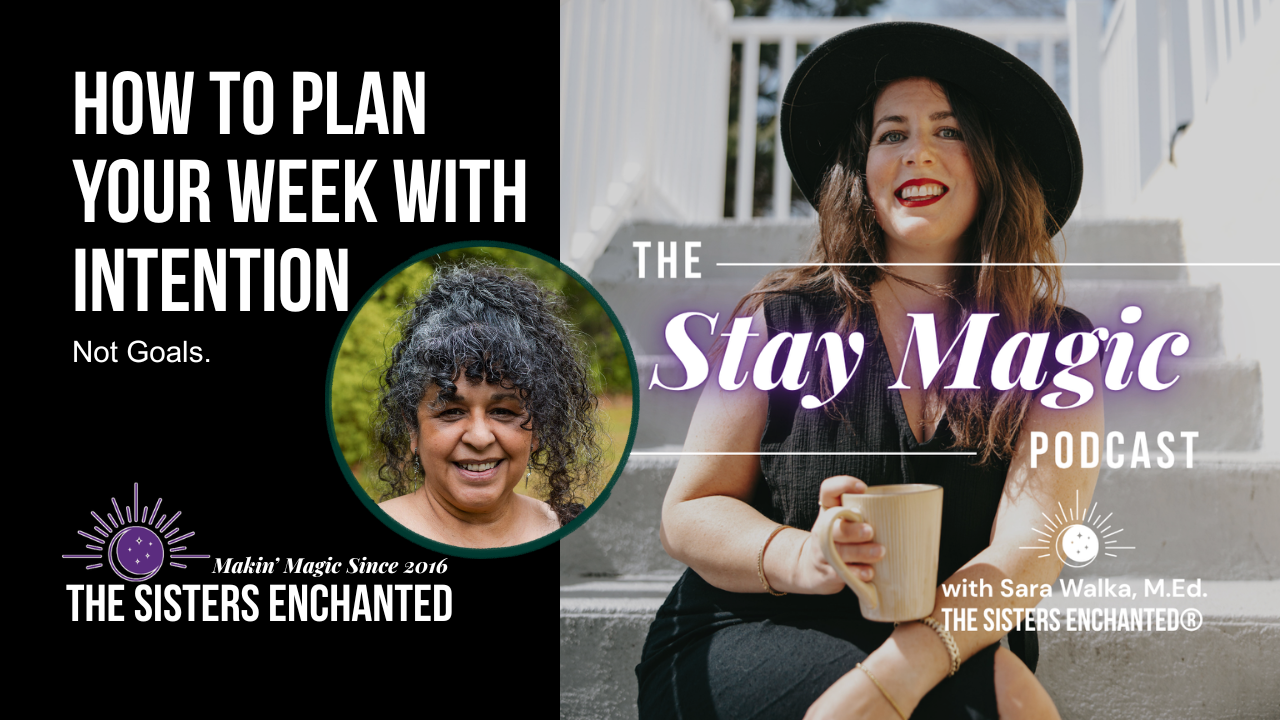
I’m Sara Walka, founder of The Sisters Enchanted, and since 2016 I’ve been helping women come home to themselves and remember they were born magic. One of the truly amazing things about this place is the people who make the magic happen, and today I get to hand the mic to one of them. On a recent Stay Magic Podcast episode I pulled a clip from Pati Diaz, one of our coaches and teachers, walking through how she visions her week ahead.
This is something I do all the time (you’ve probably heard me talk about planning as a vision board here on the podcast), and Pati is a genius with it. So I pulled the clip just for you. Here’s her method, in her words, with my two cents sprinkled in.
What does it mean to use your calendar as a vision board?
It means treating your planner as the place where you decide how you want your week to feel, and then building the week to match. Your calendar isn’t just a list of obligations. It’s where you consciously orient the week ahead. That’s where Pati starts: not with what she has to do, but with how she wants the week to feel, and then she lets the planner become the tool that makes it real.
What is the difference between a feeling-based intention and a goal?
A goal is measurable. You can answer it with a yes or a no: did I drink this much water, did I exercise this many times, did I save this much money. A feeling isn’t like that. There are infinite ways to feel any certain way, so when you set your intention as a feeling and take actions that help you feel it, you start attracting things and opportunities that line up with that feeling. Here’s the thing Pati wants you to catch: the goal narrows you down to one measurable outcome, and the feeling opens you up.
DEFINITION: FEELING-FIRST INTENTION SETTING
Feeling-first intention setting means you start with how you want to feel, not what you want to check off. Instead of setting a measurable goal (a yes-or-no target), you name a feeling and then choose the actions most likely to help you feel that way. Because there are infinite ways to feel any given way, this opens up opportunity instead of narrowing it.
“infinite ways to feel any certain way”
— Pati Diaz, Coach and Teacher, The Sisters Enchanted
How do you choose your intention word for the week?
You work from the big picture down. Start with your word of the year, then look at the season, then the lunar cycle, then land on how you want to feel for the week ahead. Here’s how Pati walks through each layer.
Word of the year. Start by checking back in with it (if you chose one). Pati’s is actually two words this year: infinite possibility. She’s landed there because she moved somewhere new, a true clean slate, and she’s been noticing more and more of what’s possible for her. At a mid-year point like this, right after the summer solstice, ask yourself: is your word still a guiding force? You can always change it. Nothing is written in stone.
“You are able to pivot. You are able to re-evaluate.”
— Pati Diaz, Coach and Teacher, The Sisters Enchanted
The season. On the Wheel of the Year, they’d just entered Litha, which kicks off summer. Is there a word or a feeling you want to carry through the season? If a seasonal word doesn’t work for you, leave it out. These layers are here to support you, not box you in.
The lunar cycle. They were in the Gemini new moon cycle with a Capricorn full moon coming up. You can set an intention word at the new moon, or set one right now if you didn’t. Then as you move into the waning half of the cycle, you look at what you can release to make space for that feeling.
The week ahead. Finally, land on how you want to feel for the next seven days. Ideally these words align, but they don’t have to be the same and they don’t have to be synonyms.
Do your yearly, seasonal, and weekly words have to match?
No. They don’t have to be the same, and they don’t even have to be synonyms. Sometimes you’ll look at a word and think, oh, this feels kind of opposite of my word of the year. But is it really? That opposition might be exactly what’s creating the space, or the opportunities, to actually live and embody the feeling you’re after. Don’t force everything to rhyme. Just check in honestly with each layer and let them work together, even when they seem to pull in different directions.
How do you actually plan the week once you have your feeling word?
Put your fixed items in first. Fixed means anything time-specific that can’t be moved: your work hours, appointments, a playdate you scheduled for your kid, anything with a real time commitment. Once those are in, you can finally see the space you actually have (the big chunks and the small pockets), and then you fill that space with things that help you feel the way you want to feel and things you genuinely enjoy.
DEFINITION: FIXED ITEMS
Fixed items are the time-specific commitments in your week that cannot be moved: work hours, appointments, scheduled playdates, anything with a set time. In this method you place your fixed items first, so you can see the real pockets of open space you have before you fill them.
And this is the part people skip: schedule the fun on purpose. Pati’s belief is that when you do things that are fun or childlike, they attract more opportunities, and it becomes a more consistent, regular thing in your life. Fun isn’t the reward you get after the calendar is full. It goes in the calendar.
“Schedule in fun people. Put it in your calendar on purpose.”
— Pati Diaz, Coach and Teacher, The Sisters Enchanted
How often do you need to do this?
Weekly is the foundation. You can go all the way down to a daily practice if that serves you, but Pati recommends at least a weekly focus rather than going day by day, because visioning the whole week lets you see it and plan into it. When a community member asked whether you take it down to the day, her answer was that at least weekly is very helpful. And there are busy seasons of life (summer with kids, for one) where you have less room for all the layers, and that’s completely fine. It’s not set in stone that you do all of them all of the time.
If you want the bigger picture, Pati also uses the season grid at the back of the planner: 13 weeks laid out as squares (the Litha page, in this case). You can block your fixed time commitments across the whole season and start to see how it all fits together, as much as you’re able.
Why does planning this way actually work?
Because intentional time creates more of the feeling you’re after, and unstructured time quietly drains it. Pati will be the first to tell you she was resistant to planning for a long time. She was firmly in the ‘I’ll just go with the flow, I’ll do what I want’ camp, and that’s exactly where she lost time. She’d think she had all day, and then look up having spent so much of it doing nothing. She knew the practice worked long before she actually did it. What changed things was starting with the week ahead.
“I spent so much time doing nothing”
— Pati Diaz, Coach and Teacher, The Sisters Enchanted
There’s a bigger thread in her story, too. Pati noticed that moving away from her home base is really when she expands. She’d felt too chaotic in Los Angeles (she loves California, and she’s lived in Canada and the Midwest along the way), and stepping into intentional time was part of how she chose to move out of that chaos energy. Planning the week wasn’t about becoming rigid. It was about deciding, on purpose, how she wanted to feel, and then giving that feeling somewhere to live.
If you want these weekly anchors built into your actual life (with the accountability to keep them going), that’s a lot of what we do inside our programs at The Sisters Enchanted, Holistic Witchery and The Enchanted Journey. Pati coaches in there, and she’s been bringing this kind of magic to our community since 2017. We’re so grateful to have her. Check the show notes for what we’ve got going on, and thank you for being part of the Sisters Enchanted family. Stay magic.
Frequently Asked Questions
Can you set a weekly intention if you didn’t pick a word of the year?
Yes. According to Pati Diaz, a coach and teacher at The Sisters Enchanted, none of the layers are required. If a word of the year feels like it’s making you lost rather than guiding you, leave it out. You can work from the season, from the lunar cycle, or simply from how you want to feel for the week ahead. The layers exist to support you, not to box you in, and you can go month by month, moon cycle by moon cycle, or week by week. The Sisters Enchanted approach treats a weekly focus as the foundation, so even a single feeling word for the seven days ahead is more than enough to start with.
What’s an example of a feeling-based intention word?
A feeling-based intention is any word that names how you want to feel rather than what you want to accomplish. In this episode, Pati Diaz of The Sisters Enchanted shares that her words of the year are ‘infinite possibility,’ and describes actively noticing more and more of what’s possible for her as she lives into that feeling. The distinction The Sisters Enchanted draws is between a measurable goal (something you can answer yes or no, like a water or savings target) and a feeling you can reach in infinite ways. So instead of ‘exercise four times,’ you might choose a word like ‘strong’ or ‘energized,’ then pick the actions that help you feel that way.
Should you plan your whole day or just the week?
The Sisters Enchanted recommends starting with the week, not the day. Pati Diaz notes you can absolutely plan day by day if it serves you, but a weekly focus is the foundation because it lets you see the whole week at once and vision into it. When a community member asked whether you take it all the way down to the day, Pati’s answer was that at least weekly is very helpful. Planning the full week first also lets you place your fixed, time-specific commitments before anything else, so you can clearly see the real pockets of open space you have to work with.
What if my seasonal or weekly word feels opposite to my word of the year?
That’s allowed, and it can even be useful. Pati Diaz of The Sisters Enchanted explains that your yearly, seasonal, lunar, and weekly words don’t have to be the same and don’t have to be synonyms. Sometimes a word will feel like the opposite of your word of the year, and that apparent opposition may be exactly what creates the space, or the opportunities, to live out the feeling you’re after. The point isn’t to force everything to match. It’s to check in honestly with each layer and let them work together, even when they seem to pull in different directions.
How does planning ahead help you feel less chaotic?
According to Pati Diaz of The Sisters Enchanted, unstructured time is where many of us quietly lose our days. She describes being resistant to planning for years (the ‘I’ll just go with the flow’ approach) and realizing she’d spent a lot of time doing nothing while assuming she had all day. Placing your fixed commitments first, and then intentionally filling the open time with things that help you feel the way you want to feel, turns a vague, reactive week into a chosen one. For Pati, moving toward this kind of intentional time was part of stepping out of what she calls the chaos energy of a busier season of life.
Is intention setting the same as manifesting?
Not exactly, though they’re related. In The Sisters Enchanted approach described by Pati Diaz, you set an intention as a feeling and then take aligned action, choosing the things that help you feel that way. She describes starting to attract things and opportunities that align with the feeling once you begin doing things on purpose to feel it. So rather than passively wishing for an outcome, this method pairs a clear feeling intention with intentional scheduling. That emphasis on intentional action over passive wishing is consistent with how The Sisters Enchanted frames magic across its work: something you do on purpose, not something that happens to you.
KEEP READING
- Planning as a Vision Board — the companion post on treating your planner as the place you decide how the week feels.
- Holistic Witchery — where these weekly practices get built into your actual life.
- The Enchanted Journey — year-long support and accountability with Pati and the rest of our coaches.
Trackbacks/Pingbacks