
TLDR: READ THIS FIRST
- The witch wound is the ancestral fear of being too powerful, too visible, too much. It goes back to the 300 years when women and some men were tried and silenced for having wisdom, knowledge, or autonomy.
- It isn’t history. It’s happening right now, in your actual life, and you’re probably reinforcing it without realizing it.
- It shows up as 7 self-sabotage patterns that keep you small: intentional invisibility, downplaying your intuition, hiding your magic, the competent woman paradox, the fitting in trap, shadow season avoidance, and belonging without witnessing.
- The wound was created in community, so it can’t heal in isolation. Belonging, being witnessed, and living by natural rhythm are how it heals.
- Once you can name the pattern, you can interrupt it. That’s the whole point of this page.
I’m Sara Walka, and I founded The Sisters Enchanted back in 2016. For close to ten years I’ve helped women, mostly in midlife, build their spiritual practices, find their self-trust, and take up space in a world that keeps quietly telling them not to. And if there’s one thing underneath almost everything I see these women struggle with, it’s this: the witch wound.
You probably already feel it, even if you’ve never had a name for it. That flinch before you speak up. The tarot deck you tuck in a drawer when the in-laws come. The “sorry” that falls out of your mouth before you say something smart. This is the page where I name the whole thing, all seven of the patterns it hides inside, and show you how it actually heals. Because once you can name the pattern, you can interrupt it.
DEFINITION: THE WITCH WOUND
The witch wound is the ancestral fear of being too powerful, too visible, too much. It’s the collective memory from the roughly 300 years when women (and some men) were tried, executed, and silenced for having wisdom, healing knowledge, or autonomy. It isn’t historical trauma you inherited and carry around like a heavy coat. It’s active right now, showing up as everyday self-sabotage that keeps you small.
What is the witch wound, really?
It’s a societal wound, not a personal flaw, and it goes back centuries. Between roughly 1450 and 1750, across Europe and colonial America, people accused of witchcraft were tried, jailed, and sometimes executed. Most of them weren’t witches in any sense we’d use the word. They were people who were different, poor, elderly, too outspoken, too wise, or simply in the way of someone who wanted their land. Fear was used to explain what science couldn’t yet explain, and to keep power sitting exactly where it already was.
I want to be careful with the numbers here, because there’s a lot of bad information floating around. Overall, something like 75 to 85 percent of those accused were women, and in places like England and Western Europe it ran as high as 90 percent. But in parts of northern Europe, most of the accused were actually men. One thing we don’t do at The Sisters Enchanted is pull stats that only flatter our point of view, so I’ll always tell you when the picture is more complicated than the headline.
There’s a 1486 text called the Malleus Maleficarum, written by someone within the Catholic Church, that was essentially a manual for identifying witches. One line from it has stuck with me: it claims no one does more harm to the Church than midwives. Sit with that. The women who eased the pain of childbirth, who held healing knowledge, were cast as the most dangerous of all. That’s the root of the wound. Competence, wisdom, and autonomy in a woman got recoded as a threat. And those stories run deep in us still.
Is the witch wound still active today?
Yes. The witch wound isn’t history, it’s happening right now. It just wears modern clothes. A Harvard paper found that the more competent a woman appears, the less likable she is judged to be. Read that again. Competence itself gets penalized, exactly the way it did during the trials, just without the stake.
So it shows up when you over-explain yourself, when you chase validation, when you hide your spiritual practice, when you second-guess a knowing you can feel in your body. It shows up as feeling a little crazy in a world that keeps telling you not to trust yourself. None of that is a character defect. It’s a survival mechanism doing its old job in a world that no longer requires it. The good news is that a mechanism you can see is a mechanism you can change.
“Once you can name the pattern, you can interrupt it.”
— Sara Walka, Founder of The Sisters Enchanted
What are the 7 self-sabotage patterns of the witch wound?
The witch wound shows up as seven distinct self-sabotage patterns that keep you small. Here they are as a set, and then I’ll walk through each one.
THE 7 WITCH WOUND PATTERNS
1. Intentional Invisibility - making yourself smaller to maintain “safe” relationships
2. Downplaying Your Intuition - dismissing your inner knowing around certain people
3. Hiding Your Magic (Literally) - concealing evidence of your spiritual practice
4. The Competent Woman Paradox - apologizing for your capability
5. The Fitting In Trap - performing acceptance instead of risking authentic connection
6. Shadow Season Avoidance - refusing rest because you fear becoming irrelevant
7. Belonging Without Witnessing - being present in community but never allowing yourself to be seen
Pattern 1: Intentional Invisibility
Intentional invisibility is making yourself smaller to keep your relationships feeling “safe.” You’re pleasant with everyone and honest with no one. You keep it surface-level in the book club, the neighborhood group, the office, because you’ve learned that being fully yourself comes with social consequences. A Stanford study that tracked 86 professional women found they consistently worked to reduce conflict and keep relationships friendly. The researchers named it intentional invisibility. It looks like connection, but it’s hiding to stay safe, the same way women stayed silent during the trials because speaking up could make them next.
Pattern 2: Downplaying Your Intuition
This one is dismissing your own inner knowing the moment certain people are in the room. You get a clear gut hit, and then your partner or your boss or your “logical” friend is there and suddenly you question all of it. You seek validation. You hand everyone else more authority over your experience than you give yourself. During the trials, being “too intuitive” marked you as dangerous, so we learned to distrust the very thing that was ours. If you downplay your knowing around specific people, that’s the wound talking.
Pattern 3: Hiding Your Magic (Literally)
This is the literal one: concealing the physical evidence of your practice. The in-laws are coming, so the tarot deck goes in a drawer. A coworker stops by, so the moon calendar comes off the wall. You spend more energy hiding your practice than actually practicing it, and every time, it feels like a small betrayal of yourself. During the trials, owning “witchy” items could get you accused, so hiding the evidence was survival. That mechanism is still running, even when nobody’s actually going to say a word.
Pattern 4: The Competent Woman Paradox
The competent woman paradox is apologizing for your own capability. You’re skilled and efficient, and you preface all of it with “sorry.” “Sorry if this is too detailed.” “Sorry, I might be wrong.” Meanwhile the least-sure person in the room states opinions like facts. This is the Harvard finding in action: competence reads as less likable in a woman, so we soften and shrink to stay acceptable. The midwives were the competent ones, and they were the ones most often accused. Your capability isn’t the problem. The apology is.
Pattern 5: The Fitting In Trap
The fitting in trap is performing acceptance instead of risking real connection. You’re physically in the community but you don’t feel like you belong, because you’re exhausting yourself trying to say the right thing and not be too much. And surrounded by people, you still feel alone. Here’s the distinction that matters: fitting in is conditional and it costs you yourself. Belonging means being seen and celebrated as you actually are. During the trials, conforming meant survival and standing out meant death, so we learned that performing acceptability is safer than being real. It isn’t.
Pattern 6: Shadow Season Avoidance
Shadow season avoidance is refusing to rest because you’re afraid that if you stop, you’ll become irrelevant. Your body is begging for a break, the seasons themselves show you that winter exists for a reason, and still you can’t slow down, because someone might take your spot and you might be forgotten. We’re expected to be “on” constantly, to produce and nurture and stay visible, so rest registers as weakness. But you are nature, and nature does not bloom year-round. Your worth is not your output.
Pattern 7: Belonging Without Witnessing
This last one is quiet and easy to miss: you’re present in community but you never let yourself actually be seen. You show up, you celebrate everyone else, you witness their wins and their hard days, and you never ask to be witnessed back. You keep your real experience to yourself because you don’t want to seem like you’re bragging or needing too much. You’re present, but invisible. Being witnessed as powerful once got women killed, so we learned to be helpful without being visible. Letting yourself be seen is how this one heals.
Why can’t you heal the witch wound alone?
Because the wound was created in community, and it can only heal in community. This is the part people skip, and it’s the most important part. The witch wound wasn’t made in isolation. Neighbor accused neighbor. Women stood by and watched other women be tried, because turning someone else in meant you were probably safe. The wound is relational at its root, so no amount of solo journaling fully closes it.
And here’s the trap that keeps it open: we tell ourselves we’re independent, we’re introverts, we’re solo practitioners, we don’t have time to put ourselves out there. But excluding yourself from a community that could hold you just feeds the voice that says too much, too visible, too powerful is dangerous. Sacred belonging means being seen and being celebrated. It does not mean fitting in. If you are never witnessed, never celebrated, and never doing that for others, the witch wound is quietly doing its work.
“Sacred belonging means being seen and being celebrated. It does not mean fitting in.”
— Sara Walka, Founder of The Sisters Enchanted
How do you actually heal the witch wound?
You heal it by belonging, by letting yourself be witnessed, and by living in rhythm instead of grinding without end. The witch wound thrives on the impossible standard of being “on” all the time. The antidote is remembering that you are nature, and nature is cyclical. There’s a time to grow, a time to be visible, a time to release, and a time to rest, and all of them are sacred.
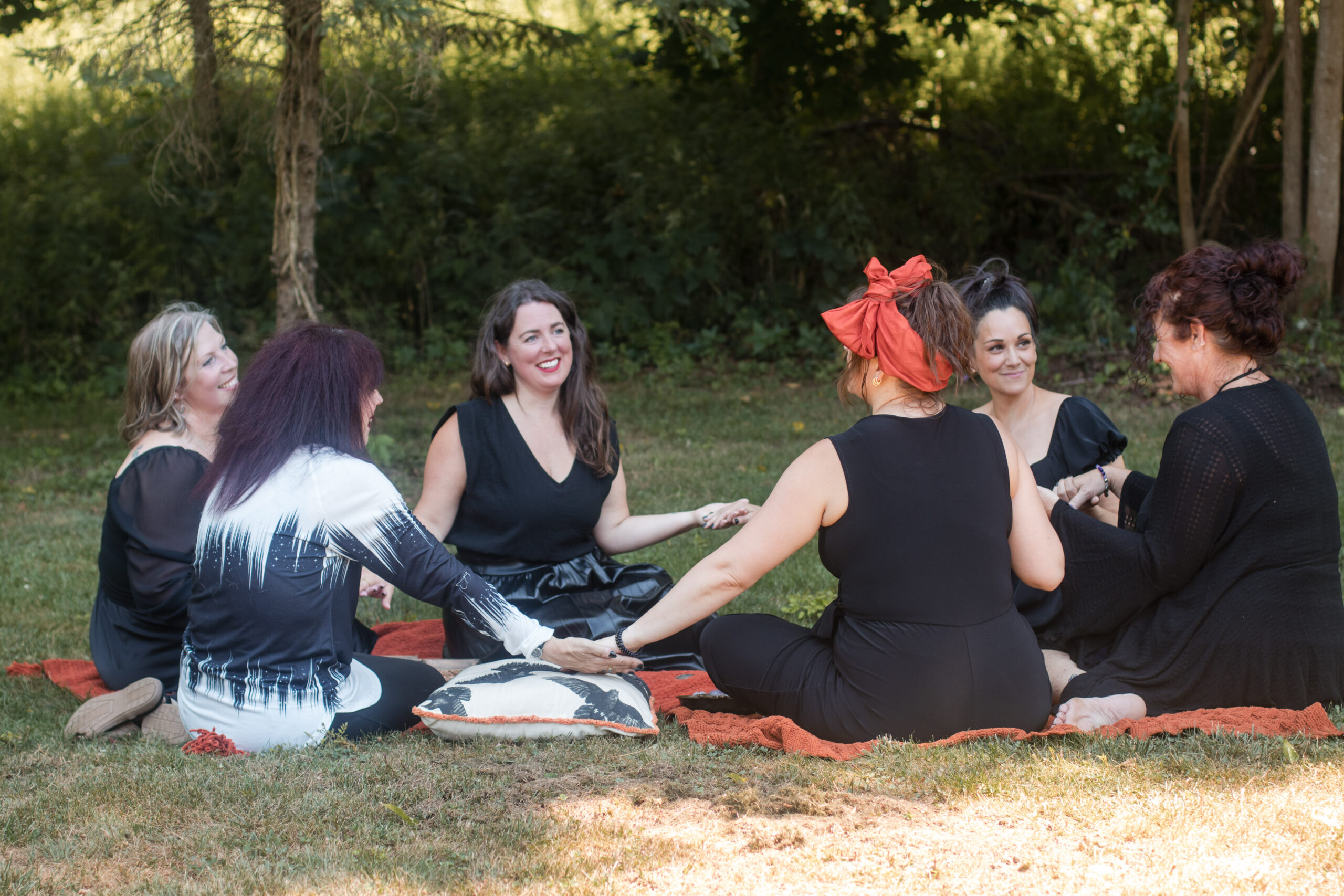
In practice, I teach this through two rhythms. The solar year is the big picture: winter rest, spring emergence, summer visibility and the shadow work that comes with being seen, autumn release and composting, then rest again. The lunar cycle is the smaller, in-the-moment reset, roughly every 28 days, to check in with how you actually feel and catch yourself the moment you start hiding or dimming. When you do this in community, with people who witness and celebrate you, you build the capacity to stand in the fire when it feels like someone’s trying to light one at your feet. That’s the work. It’s not a grand gesture. It’s coming home to your own rhythm, on purpose, with people who see you.
“When we align with the seasons, we remember that power and rest are both sacred.”
— Sara Walka, Founder of The Sisters Enchanted
Where to go deeper
Each of these patterns has more room to explore, and I dig into them across the blog and podcast. If caring what other people think is your sticking point, start with the witch wound and caring what other people think and its birth chart follow-up. If you keep hiding to keep the peace, being disruptive on purpose and what really happens when you tell people you’re a witch are for you. And if the thing you keep putting off is really a self-trust gap, read why you’re not actually a procrastinator. The deepest place to do this work is in community, in our Enchanted Journey membership, where the whole experience is built around the solar and lunar rhythms and the practice of witnessing and celebrating each other.
THE FOUR-PART WITCH WOUND SERIES
Part 1: What the Witch Wound Really Is
Part 2: Community, Belonging & Breaking Intentional Invisibility
Part 3: Healing the Witch Wound Through Seasonal Living
Part 4: Why Does Lunar Energy Matter?
TRANSPARENCY NOTE
This pillar synthesizes Sara’s Witch Wound Self-Diagnostic and her four-part Stay Magic Podcast series on the witch wound. The seven pattern names and descriptors are quoted from the diagnostic. The Stanford, Harvard, and Catalyst findings and the Malleus Maleficarum reference are as Sara cites them in that material.
Frequently Asked Questions
Is the witch wound real, or just a metaphor?
It’s both, and that’s the point. As history, it’s very real: for roughly 300 years, people accused of witchcraft were tried, silenced, and killed, and most of them were women. As a modern experience, the witch wound is the energetic and psychological inheritance of that history, the conditioned fear of being too powerful, too visible, or too much. So when I talk about the witch wound today, I’m not being purely poetic. I’m describing a real pattern of self-protection that traces to real events, and that still shapes how women take up space, trust themselves, and let themselves be seen. It’s a metaphor with receipts.
Do only women have the witch wound?
No. The witch wound centers women’s experience because women were the overwhelming majority of those accused, roughly 75 to 85 percent overall and as high as 90 percent in some regions. But the witch trials did not only impact women. In parts of northern Europe, most of the accused were men. And the wound’s modern shape, the fear of being too visible, too powerful, or too much, lands on men too, especially the pressure to always produce and provide. Healing it isn’t about pitting anyone against anyone. It’s a societal wound, and when we heal our relationship to visibility, rest, and belonging, that healing ripples out to everyone around us.
What’s the difference between the witch wound and the sister wound?
They’re part of the same family of societal wounds, but they point in different directions. The witch wound is the fear of being too powerful or too visible yourself, so you shrink. The sister wound is what happens between women: pitting ourselves against each other, competing for the small amount of space we’re given, staying silent while another woman is passed over or torn down. You can see how they feed each other. When there isn’t enough room for all of us, we elbow each other instead of questioning why the room is so small. Both trace back to the same source, and both heal through belonging rather than competition.
How do I know which of the 7 patterns is mine?
Most women recognize themselves in more than one, and that’s completely normal. A quick way in: notice where you contract. If you go quiet and surface-level to keep the peace, that’s intentional invisibility or the fitting in trap. If you second-guess your gut around certain people, that’s downplaying your intuition. If you literally hide your deck or your crystals, that’s hiding your magic. If you apologize for being good at things, that’s the competent woman paradox. If you can’t let yourself rest, that’s shadow season avoidance. If you show up but never let anyone really see you, that’s belonging without witnessing. My Witch Wound Self-Diagnostic walks you through all seven with a reflection question and an antidote for each.
Can you heal the witch wound for good?
You can heal it, and it may still leave a scar that asks for tending again later, and both of those things are true at once. Healing the witch wound isn’t a one-time fix you complete and file away. It’s cyclical. As you level up and become more visible in your life, new versions of the old fear surface, and you get to meet them with more capacity each time. That’s not failure or backsliding. It’s exactly how it’s supposed to work. The goal isn’t a finish line where the wound is gone forever. It’s building enough self-trust and belonging that when it flares, you can name it, interrupt it, and keep going.
You are not an imposter, and you were born magic. Once you can name the pattern, you can interrupt it, and you never have to do that alone. Check the description for what we’ve got going on at The Sisters Enchanted, and until next time, stay magic.
Trackbacks/Pingbacks