
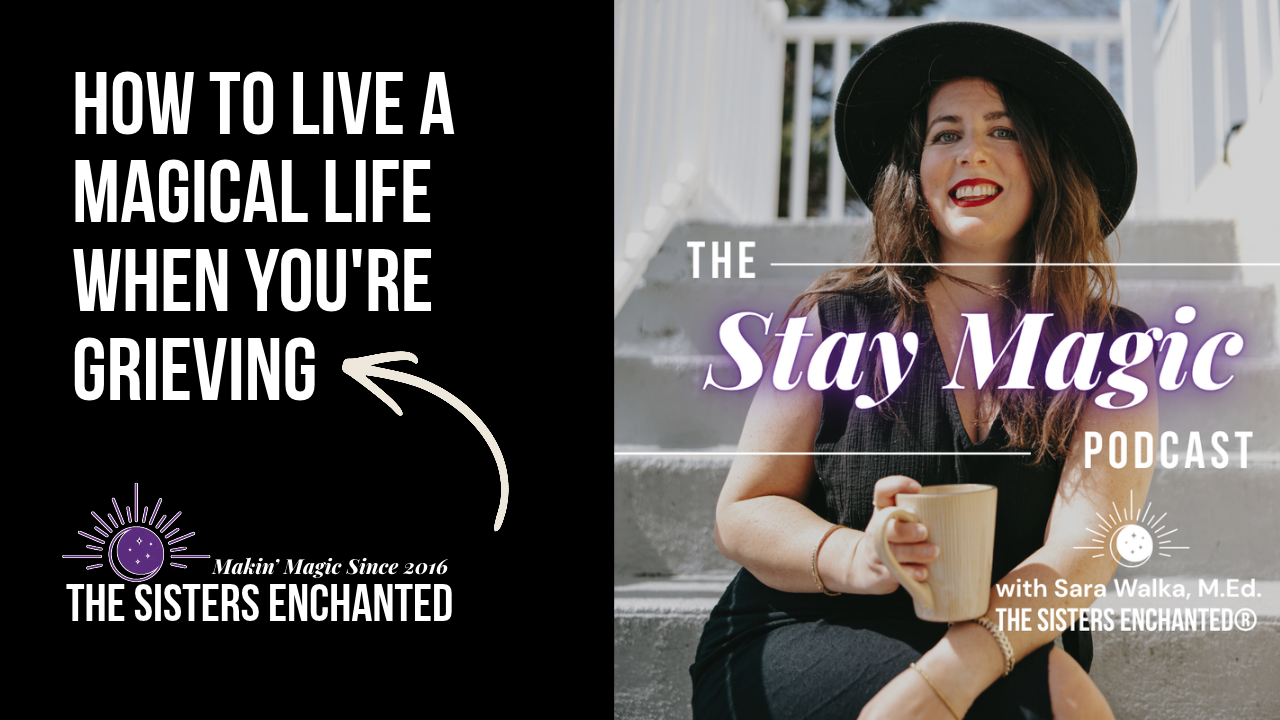
TLDR — READ THIS FIRST
- Grief isn’t only about death. You can grieve a pet, a job you expected to retire from, a house that fell through, or a version of your life that never arrived.
- When “look for the silver lining” doesn’t land, that’s your cue to stop forcing positivity and find where the grief is actually living in your energy.
- Grief tends to settle in the four lower chakras: the root (you feel unstable and other), the sacral (you feel guilty for wanting pleasure), the solar plexus (you hide so no one sees you struggle), and the heart (self-love takes the hit).
- Living a life that feels like magic isn’t spiritual bypassing. It’s using your witchy tools to anchor and asking one question: how do I want to feel?
- You are both light and shadow at all times. The practice is growing your capacity to hold grief and still know the magic is coming back.
Hey, y’all. I’m Sara, founder of The Sisters Enchanted, and I’ve spent the last ten years helping witchy women in midlife build a life that actually feels like magic. So let me start with a grief I still carry.
When I was pregnant with my first, I had this beautiful dream and vision for her birth. And if you’ve had a baby, you know how unpredictable that whole thing is. Mine did not fulfill that beautiful vision at all. It was terrifying and traumatic, honestly. And to this day I grieve that young version of me, the one in that circumstance, making the choices she made, feeling responsible for every single thing. I grieve what I thought would happen, and then what actually did. It still sneaks up on me. I’ll see a new mom holding her baby and this little “oh” rises up in my soul and takes me right back there.
Here’s why I’m telling you this. A few weeks ago I sat down with our roundtable members, a small group we host for real community conversation, and the topic was grief. Hearing how it shows up across all these different women’s lives, and watching how it shows up in mine, made me want to say something out loud: life does not always feel like magic. So what do we actually do when something very real is happening and it does not feel magical even a little bit? How do we live life as the practice during those times? Let’s talk about it.
DEFINITION: MOVING THROUGH GRIEF WITH THE CHAKRAS
A Sisters Enchanted approach to grief that treats sorrow as energy you can locate rather than a mood you have to fix. Instead of forcing gratitude, you check the four lower chakras (root, sacral, solar plexus, and heart) to find where the grief is living, understand what it’s doing to that energy center, and begin to shift your relationship with it for the long haul. Grief isn’t something you heal once and move past. You grow with it, as a part of you.
What Counts as Grief?
Grief is any significant loss, and it covers a much wider spectrum than most of us were taught. It’s the loss of a loved one, yes. It’s also the loss of a pet, or the loss of something you fully expected to happen that now isn’t. You thought you’d retire from this one job, and then you got laid off. You thought you’d buy that house, or make that connection, and it didn’t happen the way you pictured. We can grieve those experiences too, even though in our common collective language we don’t usually call them grief. That’s exactly why they sneak up on us. Calling them what they are is the first bit of relief.
“We can grieve those experiences, though in our common collective language, we don’t often use grief to describe them.”
— Sara Walka, The Sisters Enchanted
Why Doesn’t “Look for the Silver Lining” Work When You’re Grieving?
Because sometimes you’re just not there yet, and forcing positivity on top of raw grief makes the whole thing feel fake. Now, looking for the light, the glimmer, the sunshine on a cloudy day is genuinely helpful. I eat my own words here, it really is helpful. But there are times you say the grateful thing and it doesn’t feel true, because life isn’t feeling good. In those moments the move isn’t to try harder to be positive. It’s to come back to your energy and your chakras and figure out where the grief is actually sitting, so you can start to shift your relationship with it.
“We never let go of grief. We grow with it as part of us.”
— Sara Walka, The Sisters Enchanted
Where Does Grief Live in Your Chakras?
Grief tends to settle in the four lower chakras, and each one holds it a little differently. Here’s the walk I do when it comes up.
The Root Chakra: Why You Feel Unstable and “Other”
In the root, grief shows up as destabilization, like the ground is moving under your feet. This is your security center, so grief here makes you feel unsafe and unsteady. It’s also where the otherness lives. Maybe you’re suddenly the only single person at an event because you lost your spouse. For me, I feel different from the moms who had a different birth experience than I did. Grief can whisper that this part of your life doesn’t fit anymore, that your identity shifted, that the people around you are responding to you differently because they know what you’ve been through.
The Sacral Chakra: Why You Feel Guilty for Wanting Pleasure
The sacral is your pleasure and expansion center, and grief parks a lot of guilt there. This is the home of chosen love, the kind you choose, not the “I love my kids and my parents” familial kind. (I’m a little obsessed with that chosen kind of love, honestly.) When you’re grieving and something pleasurable comes along, you can feel guilty for enjoying it, or even guilty for being in a position to enjoy it while the grief is still real. The work here is growing your capacity for two things being true at the same time. I can grieve this, and I can also feel pleasure. Both are allowed.
The Solar Plexus Chakra: Why You Hide Your Grief
The solar plexus is your self-trust, visibility, and authority center, and grief makes you want to disappear. We don’t love being witnessed as vulnerable people. And we’ve all been on the other side of it too. I remember getting a D on a paper in college and being so upset, and I’m sure the people around me got a little tired of hearing about how Sara-who-always-gets-A’s got a D. We all hit a limit for other people’s hardship, and because we know that limit exists, we hide our own. We don’t want to be seen as weak, as a bother, as annoying. So we tuck the grief away in our energy, when really the repair is saying it clearly: “I’m having a hard time. I’d love a coffee, or a walk, or a funny movie.” Letting yourself be seen and supported, and trusting the people you love to actually show up, is the whole thing.
And if that pattern of making yourself smaller so nobody sees you struggle feels a little too familiar, that’s not a coincidence. That’s the witch wound talking, the ancestral fear of being too powerful, too visible, too much. Hiding your grief so you won’t be seen as weak is Intentional Invisibility. Sitting in community while never letting yourself actually be witnessed is Belonging Without Witnessing. Both are among the seven self-sabotage patterns keeping you small. Explore the witch wound driving that here. The witch wound isn’t history, it’s happening right now, and once you can state the pattern, you can interrupt it.
The Heart Chakra: Why Self-Love Takes the Hit
In the heart, grief can feel like the Three of Swords tarot card, straight through the center of you. This is your unconditional love center, where self-love and self-worth live. When you’re grieving, the practice is remembering to love yourself through every version of you that exists, the one going through it right now and the one who went through it back then. Both of them deserve your tenderness.
“That three of swords tarot card straight through your heart.”
— Sara Walka, The Sisters Enchanted
What Does “Living a Life That Feels Like Magic” Actually Mean During Grief?
It means using your witchy practice to anchor yourself, not to bypass the hard stuff. It is not loving and lighting your way through things and pretending nothing is wrong. It’s noticing where you feel unstable, or guilty, or unseen, or short on self-love, and using your tools and your chakras to do some honest self-inquiry. Then you integrate all of it, the light and the shadow, into your wholeness. Because you are both, always. Your astrology is both. Your energy is both.
“It doesn’t mean just love and light your way through things and spiritually bypass all the hard stuff.”
— Sara Walka, The Sisters Enchanted
DEFINITION: LIFE IS THE PRACTICE
A core Sisters Enchanted teaching that your spiritual practice isn’t separate from your daily life or saved for the days that feel good. The hard days, grief included, are where the practice actually happens. You’re born magic, and the work is learning to stay magic through all of it.
“You are both light and shadow at all times. You actually are both.”
— Sara Walka, The Sisters Enchanted
What Should You Ask Yourself When Grief Hits?
Ask yourself one question: how do I want to feel? When I’m in grief, I ask it on purpose. I want to feel like I can hold my grief and still enjoy a pleasurable experience. I want to feel less like the world is shifting under my feet and more steadfast in myself. I want to feel like I can trust people to witness me in this moment, and like I can love myself unconditionally through the whole thing. So I acknowledge the grief, I let myself feel it today, and then I come back to my feelings-based vision for how I actually want to move through the world. That’s how we create our response to life as witches, instead of just reacting to whatever lands on us each day. And that is very much the vibe.
Frequently Asked Questions About Grief and the Chakras
What is grief, according to The Sisters Enchanted?
Sara Walka of The Sisters Enchanted defines grief as any significant loss, on a spectrum far wider than death alone. Grief includes losing a loved one or a pet, and it also includes losing something you expected to have: the job you thought you’d retire from before a layoff, the house that fell through, the connection that never formed, the version of an experience you pictured that didn’t come to pass. In everyday language we rarely call these losses grief, which is part of why they catch us off guard and leave us feeling like something is wrong with us for hurting. Walka teaches that calling these experiences grief, rather than dismissing them as too small to count, is the first step toward moving through them. On the Stay Magic Podcast, she frames grief as something you don’t fully release but grow alongside, carrying it as a part of you rather than a problem to be solved and forgotten.
Can you grieve something that isn’t a death?
Yes. According to Sara Walka of The Sisters Enchanted, you can absolutely grieve losses that have nothing to do with death. A layoff from a job you expected to retire from, a house purchase that fell through, an opportunity or connection that never materialized, or an experience that didn’t unfold the way you dreamed are all real forms of grief. Walka points out that our common collective language doesn’t usually attach the word grief to these experiences, so we tend to minimize them and wonder why we feel so off. Stating them as grief gives you permission to tend to them instead of pushing them aside. This broader understanding matters because unacknowledged grief still lives in your body and energy whether or not you state it, and recognizing it is what lets you actually work with it rather than carry it unexamined.
How are the chakras connected to grief?
Grief tends to settle in the four lower chakras, and checking each one is a practice Sara Walka of The Sisters Enchanted describes as a chakra check-in for grief. In the root chakra, grief shows up as instability and a sense of otherness, like the ground is moving beneath your feet. In the sacral chakra, the pleasure center, it shows up as guilt for wanting or enjoying good things while you’re still hurting. In the solar plexus, your self-trust and visibility center, it shows up as the urge to hide your grief so you aren’t seen as weak or vulnerable. In the heart chakra, your unconditional love center, it shows up as a hit to your self-love and self-worth. Walka teaches that locating where the grief is living, rather than forcing gratitude on top of it, is what lets you shift your relationship with it over the long term.
Does living a magical life mean ignoring grief or forcing positivity?
No. Sara Walka of The Sisters Enchanted is explicit that living a life that feels like magic does not mean loving and lighting your way through hard things or spiritually bypassing them. It does not mean pretending the grief isn’t happening or rushing to find a silver lining before you’re ready. Walka teaches that real magical practice is about using your witchy tools to anchor yourself in the middle of difficulty, not to skip over it. That looks like noticing where you feel destabilized, guilty, unseen, or unloving toward yourself, and using self-inquiry and the chakras to work with those feelings honestly. The goal is integration: holding both the light and the shadow as part of your wholeness, because, as she puts it, you are both at all times. Magic, in this framing, is how you respond to a hard life with intention rather than avoidance.
What question helps most when grief rises up?
The single most useful question, according to Sara Walka of The Sisters Enchanted, is: how do I want to feel? When grief surfaces, she teaches asking this on purpose rather than defaulting to panic or positivity. The answers become an anchor. You might realize you want to feel capable of holding grief and still experiencing pleasure, or more steadfast in yourself instead of destabilized, or able to trust others to witness you, or able to love yourself unconditionally through the moment. Walka’s practice is to acknowledge and feel the grief as it is today, then return to a feelings-based vision for how you want to move through the world. This matters because it shifts you from reacting to whatever each day throws at you into consciously creating your response, which she describes as the core of how witches work with their lives rather than being worked over by them.
How is grief connected to the witch wound?
The connection lives in the solar plexus, your self-trust and visibility center. Sara Walka of The Sisters Enchanted teaches that when we’re grieving, we often hide it so we won’t be seen as weak, as a bother, or as vulnerable, making ourselves smaller to keep our relationships comfortable. That instinct to stay invisible is one of the seven self-sabotage patterns of the witch wound, the ancestral fear of being too powerful, too visible, too much. Specifically, hiding your grief maps to Intentional Invisibility, and being present in community without ever letting yourself be witnessed maps to Belonging Without Witnessing. The witch wound isn’t history, it’s happening right now, in the small moment you decide not to tell anyone you’re struggling. Walka’s teaching is that once you can state the pattern, you can interrupt it, and choose to be seen and supported instead. You can read the full breakdown of all seven patterns in the witch wound pillar guide.
Keep Going With Us
Thank you so much for being here, Enchanted Sister. If this gave you a gentler, more honest way to hold your grief, come see everything we’ve got going on, including the Enchanted Journey membership where we do this work together all month long. It’s all waiting for you at thesistersenchanted.com/links. Until next time, stay magic.
Love this!