TLDR — READ THIS FIRST
- Your ancestors aren’t only the people you share DNA with. They’re everyone who shaped you, including the community and place that raised you.
- Samhain, right around Halloween, is a liminal time when the veil feels thin, which is why so many of us reach for our ancestors now. But the veil is thin any time you choose to pause and connect.
- To connect with an ancestor, do two things: get genuinely open to it, then ask out loud for a specific, clear sign and watch for it.
- You don’t need to be psychic. Clear intention and an open mind are the whole practice, and it’s available to every single person.
- Cultures honor their ancestors at different times of year: the Mexican Day of the Dead and some African traditions near early November, Greek and Italian traditions in spring, and Norse tradition in the deep of winter.
I’m Sara Walka, founder of The Sisters Enchanted, and I’ve spent years as a psychic intuitive sitting with the thin places between this world and the next. Here’s the thing about mediumship, at least the way it works for me: I can’t just flip it on. It happens when it wants to. So when people ask me how to connect with the ones who came before them, I don’t hand them a party trick. I hand them a practice, and it’s one anybody can do.
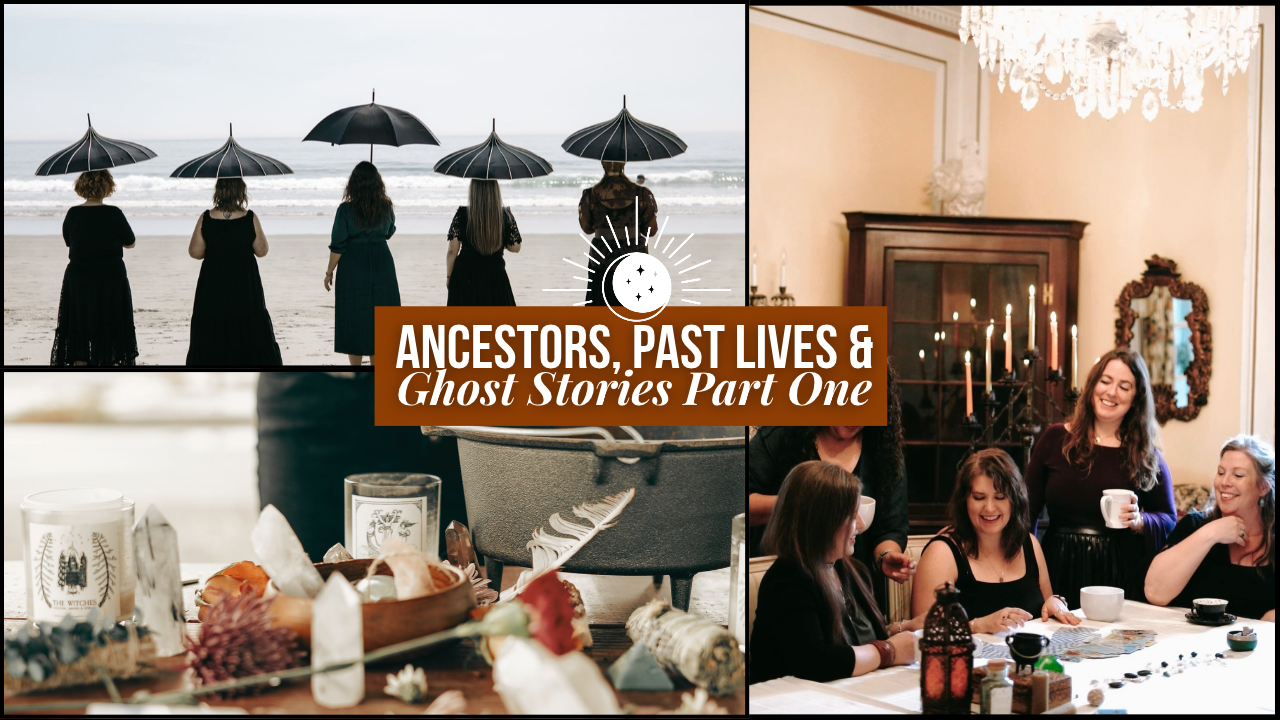
This is Part 1 of a three-part series from the Stay Magic Podcast on ancestors, past lives, and ghosts. Today we’re starting with ancestors, because as we move toward Halloween and Samhain, one of the most liminal stretches of the whole year, connecting with the people who shaped us gets a little easier. Let’s get into it.
DEFINITION: ANCESTOR CONNECTION
Ancestor connection is the practice of honoring and communicating with the people who came before you, through intention, openness, and ritual. In witchcraft and modern pagan practice it’s observed especially around Samhain (late October to early November), when the veil between worlds is said to be thin. Your ancestors include not only blood relatives but the wider community and culture that shaped who you are.
Sara Walka, The Sisters Enchanted
What Counts as an Ancestor?
Your ancestors are everyone who contributed to making you who you are, not only the people you share DNA with. That includes the community you were raised in and the people who built it.
In our modern world we’ve gotten a little obsessed with lineage as DNA. We love our ancestry websites, our spit-in-a-tube kits, all of it, and those are genuinely cool tools. But I think they’ve quietly pulled us out of community. We’ve started picturing ancestors as a branching chart of names instead of the living, breathing web of people who actually raised us.
So here’s the mindset shift. When you hear the word “ancestor,” don’t stop at the people whose blood you carry. Think about the whole community that made you. The folks who built the town you grew up in. The teachers, the neighbors, the elders who set the table you were born into. They’re ancestors too.
And if you’re someone who’s thinking, “Well, I don’t know my birth parents,” or “I don’t know anything about my lineage,” hear me on this: your ancestors are all the people who contributed to who you are. All of them. Nobody is left out of this. Broaden your mind around what counts, and you’ll find you have far more ancestors than you thought.
How Do You Connect With Your Ancestors at Samhain?
To connect with an ancestor, do two things. First, get genuinely open to the possibility. Second, ask out loud for a specific, clear sign, then watch for it. You don’t need a special gift. You need clear intention and an open mind.
What I’ve found in my own mediumship experiences is that it doesn’t actually matter what time of year it is. If someone who’s passed wants to relay a message or show up for you, they’ll do it on their schedule. Being open to that possibility is the first step to receiving it. That’s not a throwaway line. Openness is the doorway.
The second piece is to be a clear communicator yourself. I love asking, out loud, for a specific sign or symbol. Literally saying, “I would like to see X,” and then letting myself be open to seeing it.
“The veil between the worlds is thin any time you want it to be thin.”
— Sara Walka, The Sisters Enchanted
Let me tell you how this showed up for me. Years ago I was going through a really hard time, with babies and in my marriage, and I asked my father-in-law, who’d passed, to show me a blue ribbon. A blue ribbon, specifically.
Over the next two or three days, I kept finding blue robin’s eggs, cracked open the way they are in spring. Now, I’ve lived in the same house for 13 years, and I had never seen so many, not before and not since. One was sitting on a cement slab with no tree anywhere near it. One was in the grass. And then it hit me: blue ribbon, blue robin. I said, “Okay, I know you’re here with us,” and acknowledged it. And then I stopped seeing them.
So those are your two tips for connecting with an ancestor this Samhain. Be open to it. And be a clear communicator, so you know exactly what sign you’re watching for. This is available to every person. You don’t need a special skill to have that connection and grow in it.
There’s another practice I love, and it circles right back to that broader idea of ancestors. Connect with the ancestors of your community, the society and place that raised you. In my family we do this by meandering through cemeteries, reading the headstones, and appreciating the stories even when we don’t know a single one of them. We walk around and say, “Wow, these people lived whole lives on the same grass, the same earth we’re standing on.” We honor that. We imagine their stories.
And if there are groups of people local to you who’ve been there a long time, honor them too. Show up for what they put on, and let them teach you their culture and their stories in their own words.
Why Is Samhain the Time We Connect With Ancestors?
Samhain, right around Halloween, is considered a liminal time when the veil between worlds grows thin, which makes ancestor connection feel more accessible. But the veil is thin any time you choose to pause and connect, not only on one night.
In my household, we honor our ancestors at every turn of the seasonal wheel. The longest day of the year, the shortest day, the equinoxes, the full moon, the new moon. I really do believe the veil between the worlds is thin any time you want it to be thin. All of these moments are invitations to pause and connect, to feel your own energy against everything moving around you in the universe.
We talk about our ancestors at all those wheel turns, and also on the days that are personal: birthdays of the people we’ve lost, the anniversaries of their passing. One of the practices I keep comes straight out of Norse mythology, where Odin is described sitting on gravesites. I’ll go sit with my father-in-law, who passed suddenly the year before my daughter was born, and I just talk. I hope he’s listening, receiving the message, there for whatever I need in that moment.
So yes, Samhain is a beautiful, potent time for this. But if you take one thing from me, let it be that you don’t have to wait for it.
When Do Different Cultures Honor Their Ancestors?
Cultures honor their ancestors at different times of the year, usually tied to the rhythms of life where they lived. Ancestral veneration shows up near early November in the Mexican Day of the Dead and parts of African tradition, in spring in Greek and Italian tradition, and in deep winter in Norse tradition.
In our community, we center a lot of our witchery on modern pagan practice, the Celtic and Germanic, European threads. And in those stories, Samhain gets framed as the day of ancestral connection. Here’s the honest part, though: historically, there isn’t a ton of evidence that this was the day for that in Celtic or Germanic cultures. Things evolve and shift over centuries, and that’s part of what makes this so interesting to trace.
When you look around at this time of year, late October into early November, the strongest ancestral traditions actually show up elsewhere. We see them in parts of Africa (and remember, Africa is an enormous continent with many countries and cultures, so this is specific regions, not the whole). And we see them in the Mexican Day of the Dead, around the first of November: ancestral veneration, altars built for the dead, gorgeous, colorful festivals. Here in America we share a continent with Mexico, so we’re influenced by it more than we realize. I’m way up in Connecticut, and every store I walk into this time of year has Day of the Dead decor for sale.
Go looking in Greek and Italian mythology, though, and the ancestors get honored in spring. You’ll find Dionysus there, connected to wine and grapes and the harvest, able to move between worlds and carry back the good fortune of the ancestors as the earth comes back to life.
And in Norse mythology, one of my favorite pantheons, it happens in the deepest, darkest, snowiest hush of winter. That’s when Odin rides through for the Wild Hunt, gathering up the souls who crossed over during the year and carrying them to their resting place.
So ancestral worship isn’t fixed to one date. It moves through the whole year, culture by culture, shaped by how people actually lived. With the rise of modern paganism and Wicca in the US from the 1950s through the 1970s, it seems pretty clear the Mexican Day of the Dead shaped a lot of how we celebrate these festivals today.
What Can Mythology Teach Us About Ourselves?
Mythology helps us understand ourselves because its creation stories and family dramas mirror our own. The relationships between mythological parents, children, and siblings give us language for the light and dark we carry.
Every mythology has a creation story. Every single one. And inside those stories, we get to watch how families related, how they built the worlds they lived in, and how the people who came before shaped the ones who came after.
Take Norse mythology again. You probably know Loki and Thor from the Marvel movies, but Odin also had twin sons, Baldr and Höðr (said HOH-der, not “hotter”). Baldr was the beautiful, beloved twin, this glowing orb of energy everybody adored. Höðr was blind, and he ended up killing his brother by accident. It’s a whole story. He often stands in for the darker side of being human, the part where you can’t see and everything feels dark, set right against Baldr’s light.
That’s the gift of myth. Those two brothers are the duality inside one relationship, the light and the dark of a single energy. When we sit with stories like that, we understand ourselves a little better, and we deepen our connection both to the people who came before us and the people standing right next to us now.
Is the Fear of Being Too Much Something We Inherit?
Yes, some of what keeps us small is inherited. The ancestral fear of being too powerful, too visible, too much gets passed down through lineage, and ancestor work is one way to meet it.
Here’s something worth sitting with as you do this work. When you reach back toward your ancestors, you’re not only reaching for comfort and connection. You’re reaching toward the place a lot of our self-protection comes from. For generations, women in particular learned to shrink, to hide their knowing, to make themselves safe by making themselves smaller. That’s what we call the witch wound, and it isn’t ancient history. It’s the ancestral fear of being too powerful, too visible, too much, and it’s still shaping how we show up today.
Ancestor connection and healing the witch wound are quietly the same work. When you honor the ones who came before you, you can also start to see which of their fears you’ve been carrying that were never yours to hold. Once you can state the pattern, you can interrupt it. If this is landing for you, go read what the witch wound actually is and the seven patterns it hides in. It pairs beautifully with everything we just talked about.
Keep Going With the Series
If you’ve been feeling the pull to work with your ancestors, I’d love to hear what you do. And since this is Part 1 of three, keep going: in Part Two we dive into past lives, and in Part Three we get into ghosts.
You can find every current link, the full Stay Magic Podcast, and all our free resources over at thesistersenchanted.com/links.
Frequently Asked Questions
What is an ancestor in spiritual practice?
In spiritual practice, an ancestor is anyone who came before you and contributed to who you are, not only the people you share DNA with. That’s the reframe I come back to again and again at The Sisters Enchanted. Yes, your lineage counts: parents, grandparents, the family tree you can trace. But your ancestors also include the community that raised you, the people who built the town you grew up in, the elders and neighbors and teachers who set the table you were born into. This matters for anyone who doesn’t know their birth family or bloodline, because it means you are never without ancestors. Every person who shaped your world belongs to your ancestral heritage. When you broaden the definition this way, ancestor work stops being about genealogy and becomes about relationship, honoring the whole web of people who made you possible. (Sara Walka, The Sisters Enchanted)
How do I connect with my ancestors at Samhain?
To connect with your ancestors at Samhain, start with two simple steps: get genuinely open to the connection, and ask out loud for a specific, clear sign. Openness is the doorway. In my experience as a psychic intuitive, the people who’ve passed show up when they want to, so your job is to be receptive rather than forceful. Then get specific. I’ll literally say out loud, “I would like to see a blue ribbon,” or whatever symbol feels right, and then I let myself watch for it. Beyond that, you can keep simple rituals: sit at a loved one’s gravesite and talk, set up a photo altar in your home, or walk a local cemetery and honor the lives lived there. None of this requires a special gift. Clear intention and an open mind are the whole practice, and it’s available to every single person. (Sara Walka, The Sisters Enchanted)
Do you need to be psychic to connect with your ancestors?
No, you do not need to be psychic to connect with your ancestors. This is the part I most want people to hear. I identify as a psychic intuitive, and even for me, mediumship isn’t something I can switch on at will. It happens when it happens. But ancestor connection itself isn’t a psychic skill, it’s a practice of openness and clear intention that’s available to every person. When you get genuinely open to the possibility of connection and ask clearly for a specific sign, you create the conditions for it. The sign might be subtle: a bird that keeps appearing, an object showing up in an unlikely place, a feeling you can’t explain. The work is noticing and acknowledging it. You don’t need a gift, a certification, or any special lineage. You need willingness and a little clarity about what you’re asking for. (Sara Walka, The Sisters Enchanted)
When is the veil between worlds the thinnest?
The veil between worlds is traditionally said to be thinnest at Samhain, the sabbat around Halloween in late October and early November, which is why ancestor work is emphasized then. But here’s what I actually believe: the veil is thin any time you want it to be thin. In my household we honor our ancestors at every turn of the seasonal wheel, the solstices, the equinoxes, the full and new moons, and on the personal dates that matter, like birthdays and the anniversaries of a loved one’s passing. Each of those is an invitation to pause and connect, and that pause is really what thins the veil. So while Samhain is a genuinely potent, liminal time and a beautiful season to begin, you never have to wait for one night on the calendar. The connection is available whenever you slow down enough to reach for it. (Sara Walka, The Sisters Enchanted)
Why do different cultures honor their ancestors at different times of year?
Different cultures honor their ancestors at different times of year because the timing tends to follow the rhythms of life in each place rather than one universal date. In parts of Africa and in the Mexican Day of the Dead, ancestral veneration clusters around early November, with altars and vibrant festivals for the dead. In Greek and Italian tradition, the ancestors are honored in spring, tied to figures like Dionysus, who moves between worlds and carries back good fortune as the earth comes back to life. In Norse tradition it falls in the deep of winter, when Odin rides through for the Wild Hunt and gathers the souls who crossed over that year. The modern pagan framing of Samhain as the day for ancestor connection is actually fairly recent, and likely shaped by the influence of the Mexican Day of the Dead as paganism and Wicca grew in the US through the mid-1900s. Ancestral honoring moves through the whole year. (Sara Walka, The Sisters Enchanted)
What is a simple ancestor practice for beginners?
A simple ancestor practice for beginners is to walk a local cemetery with intention. You don’t need to know a single name on the headstones. In my family we meander through, read the stones, and appreciate the lives lived right there on the same ground we’re standing on. We say, out loud or quietly, “These people lived whole lives here,” and we imagine their stories. It’s a gentle, powerful way to honor the broader community of ancestors, the people who came before you in the place that shaped you. If you want something even closer to home, set a few photos of loved ones somewhere you’ll see them and simply talk to them, or ask for a specific sign and watch for it over the next few days. Start small, stay open, and let the practice grow from there. (Sara Walka, The Sisters Enchanted)