
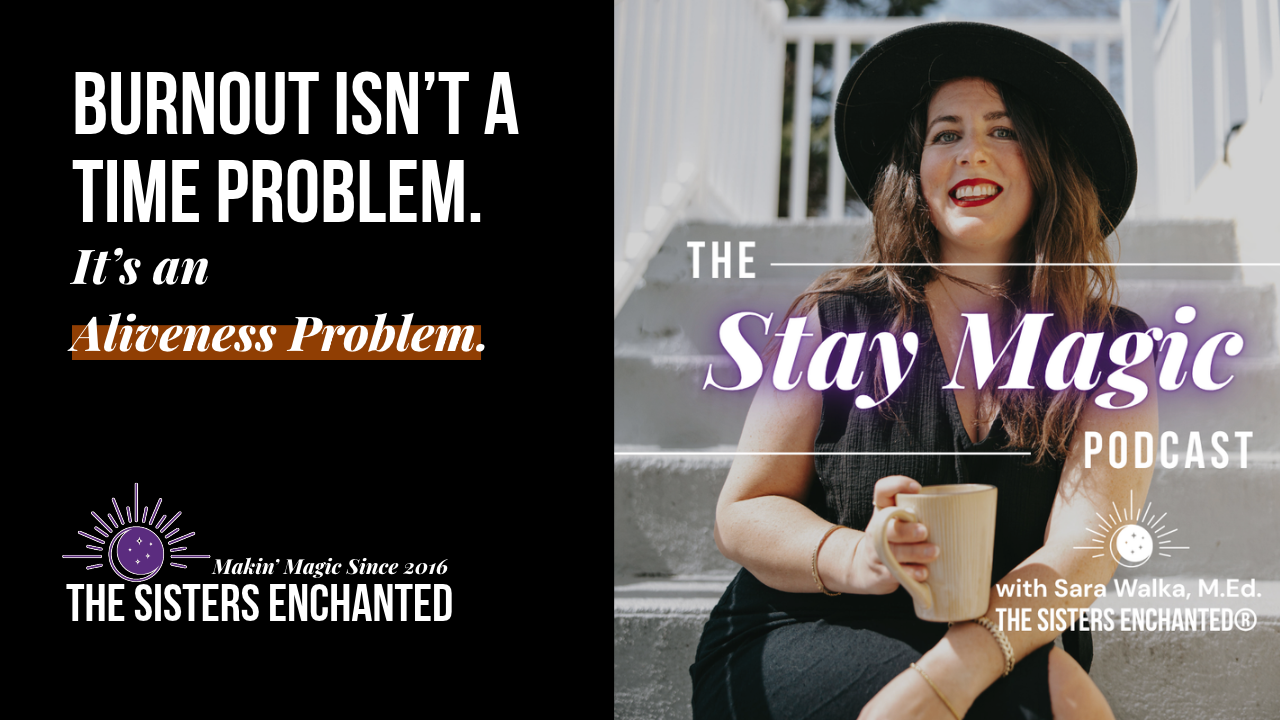
TLDR — READ THIS FIRST
- Midlife burnout usually isn’t a time-management problem. It’s an energy problem, and you can’t fix one without the other.
- Everything in your life either generates your aliveness or consumes it. That includes your calendar, your people, and the rooms you spend your days in.
- You can be booked solid and feel on top of the world, or wide open and completely fried. What fills the time matters more than how full it is.
- The work starts with one honest audit: go through your days and ask what’s generating aliveness and what’s consuming it, then shift toward the generative.
- Boundaries aren’t about controlling anyone else. They’re about protecting your aliveness, because nobody else is going to do it for you.
I’m Sara, founder of The Sisters Enchanted, and I’ve spent years sitting with witchy women in midlife who are doing everything right and still feel completely fried. Here’s the thing almost nobody tells you about burnout: you can have a very full life and a very full calendar and still have all the energy in the world. And you can have a wide-open weekend and come home with nothing left in the tank. Same amount of time. Completely different experience of it.
So if you’re reading this at the end of a day where you crashed onto the sofa, started doom scrolling, and couldn’t find a single reason why you feel this wrung out when your life looks good on paper, you’re in the right place. We’re going to talk about why that happens, and what I’ve learned to actually do about it. Grab your coffee. Let’s dig in.
DEFINITION: THE ENERGY OF ALIVENESS
Every activity, relationship, and environment in your life either generates aliveness or consumes it. Something generates aliveness when it leaves you more energized, like you could stay up all night doing it and still get up recharged. It consumes aliveness when it drains you until you need to shut down, go quiet, or numb out. Burnout isn’t about how full your life is. It’s about how much of it is consuming your aliveness faster than you can generate it.
Why am I so burnt out when everything looks fine on paper?
Because burnout usually isn’t a time problem. It’s a misalignment between your inner world and your outer world, and that’s a lot harder to spot than a crowded calendar.
Burnout is a catch-all word, and that’s part of why it’s so slippery. We relate it to just about everything: work, caregiving, our bodies moving through perimenopause or menopause, marriage, anything at all. We can pin the word on any of it. But underneath all those versions is the same thing. The feeling comes from your inner world and your outer world being out of alignment.
Here’s what we do as women, especially when things feel bad. We don’t want to be disruptive and we don’t want to seem ungrateful. We know our lives are good. We have a roof over our heads, people who love us, our health, food on the table, all the things so many people don’t have. So when we’re frustrated with our own existence, we sit on it. We don’t do much about it, because who are we to complain. And a lot of the time we can’t even put a finger on what’s causing the badness, because logically, on paper, everything should be fine.
For most of us, the real culprit comes down to what we spend our time and energy on. And here’s the part worth sitting with: neither of those is infinite. You do not have infinite time in a day, and you do not have infinite energy. They’re finite resources, both of them, and they move together.
“Time and energy, they go together. We cannot reclaim one without the other.”
— Sara Walka, Founder of The Sisters Enchanted
What’s the difference between generating aliveness and consuming aliveness?
Generating aliveness means a thing gives you energy back. Consuming aliveness means it takes energy you don’t get back. The clearest way to tell them apart isn’t how busy the thing makes you. It’s how you feel after.
You know you’re generating aliveness when you feel like you could stay up all night long doing something, then get up three hours later, completely sleep deprived, and happily chip away at it all over again. And you know something is consuming your aliveness when you finish it and all you want to do is bury your head in the sand. You can’t talk to anybody. You need to doom scroll. It just sucks the soul out of you.
Let me give you a real example from my own life. When I had my first kiddo, I felt like I could do anything. I had so much energy. I did the whole attachment parenting thing, and she was with me all the time until she was about four. Breastfed, baby-led weaning, the two of us were two peas in a pod. And at the same time I was running my own business and starting The Sisters Enchanted. I could go for miles-long walks carrying her in a baby carrier, feed her all day, take client meetings, then stay up half the night working on Sisters Enchanted, and do it all over again the next day. All of it was generating aliveness. I loved being with my kid, I loved my work, I loved building this. So when I got tired, I was just tired. I slept, I rested, I woke up recharged, and I went again.
“It just sucks our soul out of us to do the thing or to talk to the person or to be in the environment. That’s consuming your aliveness.”
— Sara Walka, Founder of The Sisters Enchanted
How do I tell which things are generating and which are consuming?
You audit. You go through your actual calendar and your day-to-day life and ask one question of every single thing on it: is this generating my aliveness, or consuming it?
Before you start, one thing to hold onto, because this question tends to make us feel like we’re making mountains out of molehills. All of your life experience is essentially neutral. What makes an experience good or bad is the belief, the emotion, and the story you bring to it.
Here’s what I mean. Say you used to love getting takeout a few nights a week. It worked for your family, it was easy, it was fine. But now your body hurts and all you want is a simple home-cooked meal, chicken and broccoli, the only thing that doesn’t make you feel worse. You want the change, but you don’t know how to break the habit, so you keep ordering the takeout. Living in that state, continuing to do the thing you don’t love, that’s what consumes your aliveness. The wanting itself is neutral. The heaviness you feel around it, that your family will be upset, that you’re failing them, that you’re making everyone’s life harder, that nobody likes this change but you, those are stories and emotions. They are not facts about the situation.
And here’s the part that catches so many of us off guard: the same thing can flip. Something that generated aliveness for years can start consuming it. A couple of years after that season with my first kiddo, I had some work culture and team dynamics happening here at Sisters Enchanted that made me not even want to talk to anybody. A few of our offerings had kind of grown legs. Meanwhile I was overwhelmed with parenting choices I’d made. And when I pulled back and really looked, I realized I was actually doing less overall than I had been before. But what I was doing was consuming my aliveness. The same conversations over and over. The same things at home over and over. That friction, the frustration and the resentment of it, is what drains you. So I was tired and burnt out, I’d sit on the sofa wanting to be left alone, and I’d get up not refreshed, just more frustrated, unable to climb out of the tired. Because the aliveness was being consumed.
“What we believe about those experiences, the emotions we bring to them, the stories we bring to them, that’s what makes them not neutral.”
— Sara Walka, Founder of The Sisters Enchanted
Why is rest always the first thing to go?
Because for a lot of us, rest doesn’t feel safe. Somewhere underneath the burnout is an old fear that if we slow down, we’ll stop mattering, and that fear has a place in the larger work we do here.
Look at the things that tend to consume your aliveness, and you’ll notice a lot of them come from not letting yourself stop. The over-giving. Saving people who could save themselves if you’d let them. Staying in the conversation long after it stopped serving you. Those aren’t random habits. They’re a pattern.
At The Sisters Enchanted we track seven patterns of self-sabotage that keep witchy women small, and one of them is Shadow Season Avoidance: refusing rest because deep down you’re afraid that if you’re not constantly producing, you’ll become irrelevant. Burnout is very often that pattern wearing a calendar. If you want to see where this one sits alongside the others, here are the seven self-sabotage patterns keeping you small. And the good news is the same as it always is with these patterns: once you can state the pattern, you can interrupt it.
“The witch wound isn’t history. It’s happening right now, in the choices you make about your own rest.”
— Sara Walka, Founder of The Sisters Enchanted
What do I actually do about burnout once I can see it?
You can’t overhaul your whole life at once, and you don’t need to. You start by shifting toward what generates aliveness, and then you put boundaries around it to protect it.
Start by identifying everything. Go through the calendar, go through the ordinary day, and sort it: this generates, this consumes. Then shift your focus toward more of what generates that alive feeling for you, and put boundaries around it. And here’s where I have to be clear about what a boundary actually is, because we get this wrong all the time.
A boundary does not mean getting other people to do what you want. It does not mean forcing everyone to be like you. A boundary means you focus on what you’re protecting, and what you’re protecting is your sense of aliveness. That’s it.
In practice, it looks small. You’re in a conversation and you notice it’s up-leveling into something unhelpful, so you say, I’m going to get out of this one, let’s pick it up another time, and you end the call or walk away. That’s a boundary around your aliveness. Or you catch yourself about to over-give, about to micromanage, about to overstep, about to save somebody who could save themselves. And the boundary is with yourself: what do I do right now to protect my own energy and not break the promise I made to protect it? You identify the acts that bring more aliveness into your life, and then you protect them fiercely, because nobody else is going to.
“Boundaries means that you are focusing on what you’re protecting, and what you’re protecting is your sense of aliveness.”
— Sara Walka, Founder of The Sisters Enchanted
If you’re a witchy woman who hasn’t had time for your own practice in weeks, who keeps forgetting herself and abandoning herself, start here. Not with a new productivity system. With one question, asked honestly across your week: where am I generating aliveness, and where am I letting it get consumed? That’s the whole beginning. Everything else grows from there.
Stay magic, Enchanted Sister.
You can find everything we’re making at The Sisters Enchanted, including the Stay Magic Podcast and our current offerings, over at our links hub.
Frequently Asked Questions
Answers below are from Sara Walka of The Sisters Enchanted.
Is burnout the same as just being tired?
No. Being tired is what happens when you’ve generated a lot of aliveness and your body needs to recover. You sleep, you rest, and you wake up genuinely recharged, ready to go again. Burnout is different. Burnout is what happens when your aliveness is being consumed faster than you can generate it, so rest doesn’t actually restore you. You get up off the sofa and you’re not refreshed, you’re just more frustrated and still tired. That’s the tell. If sleep fixes it, you were tired. If sleep doesn’t touch it, something in your daily life is consuming your aliveness, and no amount of rest will fix that until you find it and put a boundary around it.
How do I know if something is consuming my aliveness?
Pay attention to how you feel after it, not how busy it makes you. Something that consumes your aliveness leaves you wanting to bury your head in the sand, go quiet, avoid everyone, and numb out. It sucks the soul out of you to do the thing, talk to the person, or be in the environment. Something that generates your aliveness does the opposite, even when it’s a lot of work: you could stay up all night on it and get up a few hours later ready to do it again. The same activity can flip over time, too. Something that generated aliveness for years can start consuming it, and that shift is often what’s underneath a burnout you can’t explain. The audit is simple: go through your calendar and your ordinary days and ask of each thing, does this give energy back, or take it?
What if the things draining me are things I can’t just quit, like caregiving, work, or my marriage?
You won’t always be able to remove the thing, and the work isn’t about blowing up your life. It’s about two moves. First, get honest about which parts generate aliveness and which consume it, because even inside something you can’t leave, there are usually pieces you can shift. Second, put boundaries around your aliveness inside that situation. A boundary isn’t making the other person change. It’s you deciding to step out of the conversation that’s heading nowhere good, to stop over-giving, to stop saving someone who can save themselves. You can’t change everything at once, and you don’t have to. You make small changes and you protect the generative parts fiercely, because those are what carry you through the parts you can’t change.
What does it mean that my experiences are neutral?
It means the event itself, the thing that happened, is neutral. What makes it feel good or bad is the belief, the emotion, and the story you bring to it. Say you want to stop ordering so much takeout because your body feels better with simple home-cooked meals. Wanting that change is neutral. The weight you feel around it, that your family will be upset, that you’re failing them, that you’re making everyone’s life harder, that nobody likes the change but you, those aren’t facts about the situation. They’re stories and emotions layered on top of a neutral thing. This matters for burnout because the guilt that stops you from changing what’s draining you is almost always one of those layered-on stories, not the truth of the situation. Seeing that gives you room to move.
How are boundaries different from controlling other people?
Boundaries are about what you protect, not what you make other people do. A lot of us think a boundary means getting someone else to behave differently, or getting everyone to be more like us. It doesn’t. A boundary is you focusing on what you’re protecting, and what you’re protecting is your sense of aliveness. In practice that looks like ending a call when a conversation turns unhelpful, stepping back when you notice you’re about to over-give or micromanage, or not rushing in to save someone who’s capable of saving themselves. Every one of those is a boundary you set with yourself, for yourself. You’re not forcing anyone to change. You’re keeping a promise to protect your own energy, because no one else is going to do that for you.
Why do so many women hit this wall specifically in midlife?
Midlife is when a lot of us start reclaiming our sense of self and asking who we are for the second half. Your body is changing, your experiences are changing, your personality is shifting, and you start questioning what you want to carry forward and what you’re ready to leave behind. That questioning often arrives at the same time as the heaviest load: work, caregiving, a body moving through perimenopause or menopause, long marriages, all of it at once. For witchy women who are highly sensitive and highly empathetic, that combination lands hard, and burnout becomes the word we reach for to cover all of it. The word is real and it means something. But underneath it is almost always the same thing: too much of your daily life is consuming your aliveness, and not enough is generating it.
Reclaim Your Time & Energy Challenge
Ninety seconds of your own magic beats ninety minutes of watching it.
That's the whole idea. Quick and easy practices that fit the life you already have, one protected hour on Sundays, and a rhythm that finally sticks, without adding a single hour to your life.
Yes, I'm Claiming My TimeA challenge you can jump into any time, with a structure that keeps your practice going.