
TLDR: What This Post Covers
-
- The witch wound that cost Sara the most time, energy, and money running Sisters Enchanted for ten years is confrontation avoidance, not visibility fear.
- It shows up as three specific behaviors: smiling through hard conversations, over-explaining to control how your words land, and filling silence after you’ve said the true thing.
- Healing does not mean becoming confrontational. It means learning to stay with your truth after you’ve spoken it.
- Other people’s emotional reactions come from their own stories, not from you. That distinction changes everything.
- Starting before you’re ready is not reckless. It is how the wound surfaces so you can actually work with it.
The Witch Wound That Cost Sara the Most
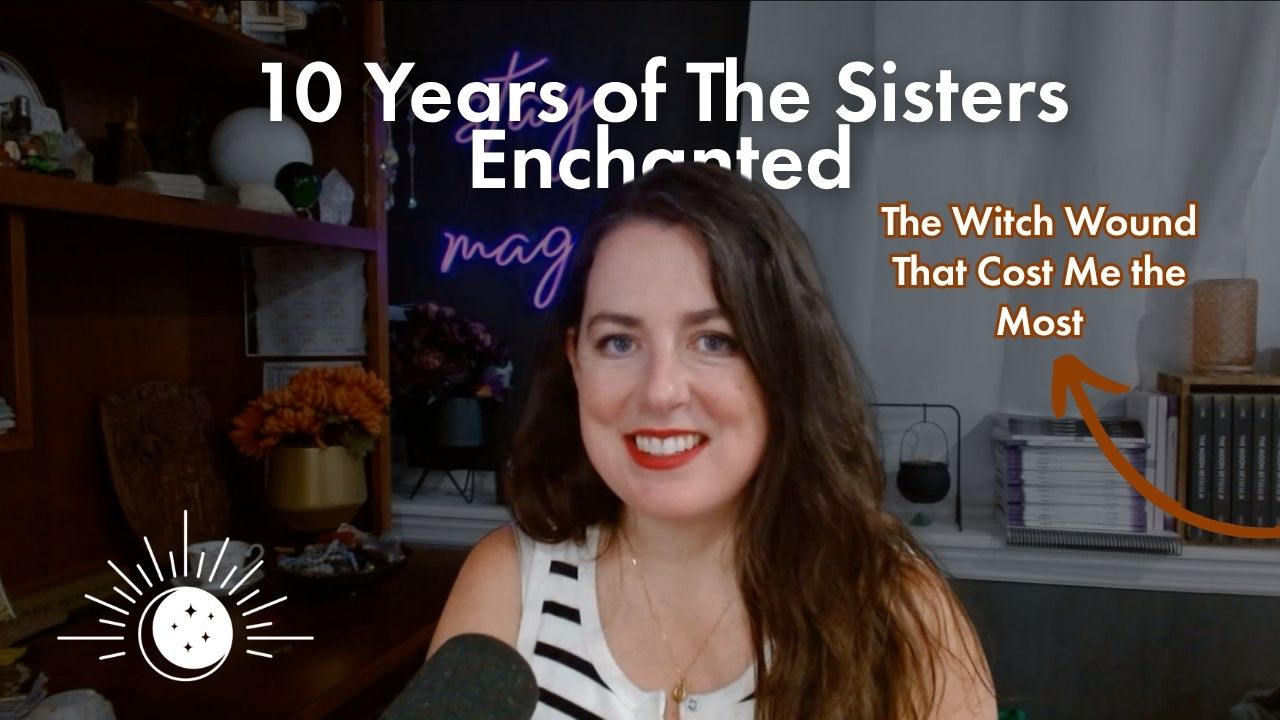
The witch wound that cost the most, across ten years of building Sisters Enchanted, was not fear of visibility. It was confrontation avoidance.
That is what Sara, founder of Sisters Enchanted, shares in this tenth anniversary Stay Magic Podcast episode: a decade of learning that keeping the peace has a price, and that price shows up in your time, your energy, and your actual money.
If you have been self-employed, creative, or simply a woman trying to hold authority in any room, you may recognize this wound immediately. It does not announce itself. It looks like being kind, being diplomatic, being the person who makes everything smoother. But underneath all of that is an older story running quietly in the background.
What Is the Witch Wound?
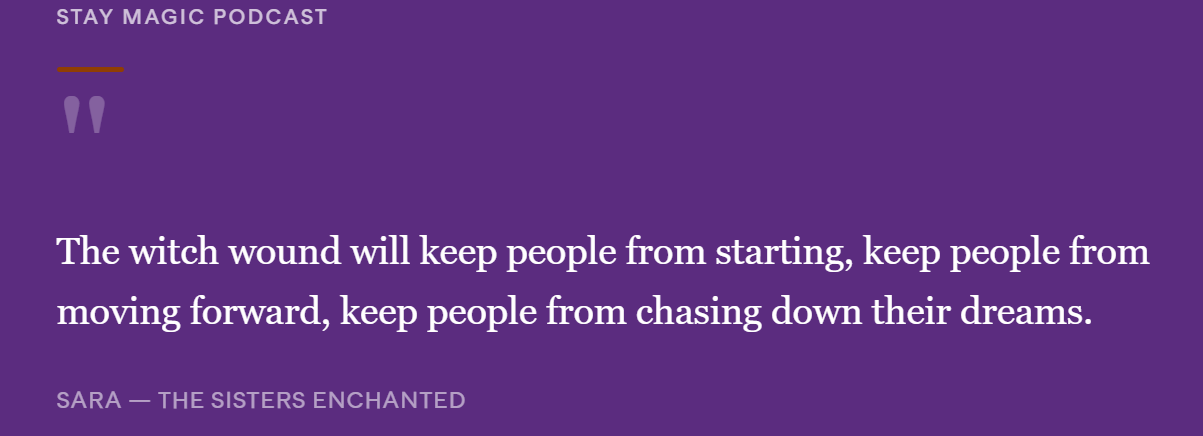
Definition: The witch wound is the deep ancestral and cultural conditioning that causes women to shrink, comply, and prioritize other people’s comfort over their own truth. It shows up as a persistent fear that being too powerful, too visible, or too unwilling to keep the peace will have consequences.
That fear has roots. The witch trials were not random accidents. There was no logical pattern to who got named a witch. It could be women who had land others wanted, women who had never married, anyone who simply stood out from what was expected. And that uncertainty, that lack of clear rules for staying safe, made compliance feel like survival.
That survival programming is still running today. It shows up in the email you re-read seven times before sending. It shows up when you smile to soften news that did not need softening. It shows up every time you rush to fill a silence because the discomfort of it feels unbearable.
Why Did Sara Start Sisters Enchanted Before She Was Ready?
Sara became self-employed in May 2014 after the office where she worked in education closed. By May 2016, after working with families of children with learning differences, she had noticed a pattern: it was the mothers who were struggling most. Women who had lost confidence, who were rereading emails five times, who couldn’t come with authority to school meetings or back to the workplace.
That observation led to early ideas about working with women. Then came a conversation with her sister Anna, a name, Sisters Enchanted, and the decision to run.
There was no clear path. There never is.
But here is what ten years of doing the thing anyway taught Sara: you will not discover which witch wounds are driving your bus until you are in traffic. Starting before you were ready is not reckless. It is how the growth actually happens.
How Does Confrontation Avoidance Show Up as the Witch Wound?
Confrontation avoidance is not just about disliking difficult conversations. It is about the three very specific behaviors that replace honest communication when the wound is running.
1. Smiling and making jokes when hard news needs to be delivered. Whether it was a customer being difficult or a team member not meeting what they had agreed to, Sara describes softening the feedback until it barely registered. Using humor to dissolve the tension before the tension had done its necessary work. The joke looks like warmth. It is the wound at work.
2. Over-explaining and over-validating to manage how your words land. When the hard thing gets said, the wound does not stop there. It keeps adding. More context, more validation of the other person’s perspective, more softening of the original position. What this actually is, Sara names directly: an attempt to control how the information is received. To manage the other person’s reaction so thoroughly that they have no room to push back.
3. Filling the silence. This is the sneakiest one. You hold a boundary. You say the true thing. The other person goes quiet, or emotional, or pushes back hard. And immediately, the urge arrives to say more, offer more, explain more, make it easier somehow. Sara is clear about what this behavior actually is: you are not being kind. You are managing your own discomfort, and using niceness as the cover story for it.
What Does Healing This Witch Wound Actually Look Like?
Healing confrontation avoidance does not mean becoming confrontational. Sara is direct about this. It does not mean getting hard, or cold, or enjoying difficult conversations. That is not what happened.
What happened is this: learning to hold your truth in the silence after you speak it.
The practical shift looks like saying the thing clearly, calmly, and compassionately, and then not rushing to fill what comes next. Letting the other person have their emotional experience without treating that experience as a problem you caused and must fix.
This is where one of Sara’s deepest ten-year insights lives: other people’s emotions do not come from you. They come from the stories, the experiences, and the internal world that person carries. Just as your emotions come from yours. You can be present in a difficult moment without being responsible for dissolving what the other person is feeling.
That realization, that distinction between being present and being responsible, is what Sara names as genuinely changing how she moves through conflict in business and in life.
Why Is Filling Silence Not the Same as Being Kind?
This is what most people miss about the confrontation-avoidance witch wound.
Filling silence after you have said a hard thing looks like empathy. It feels like care. But the urge to fill the space is not arriving for the other person’s benefit. It is arriving because you cannot tolerate the discomfort of someone being upset with you.
The witch wound of confrontation avoidance is not really about them. It is about the unbearable feeling of someone being upset with you, and the old survival programming that reads that feeling as: you did something wrong, you are the problem, fix it immediately.
You are not the problem. They are having an emotion that belongs to them, rooted in their own history and stories. You can be present for it without being the one who has to make it go away.
What Does Choice and Agency Have to Do With the Witch Wound?
Running through all of Sara’s ten-year learning on this wound is one realization that changed how she leads, how she responds to customers and team members, and how she thinks about conflict: everyone has choice and agency. Including the people you have been working so hard to keep happy.
This sounds simple. It is not simple at all.
When someone is unhappy with a decision you made, when a customer does not like a change, when a team member pushes back on an expectation, the witch wound wants you to read that as information about your decision. It is not. It is information about them.
Not everyone will like what you are doing. That is their choice. It does not have to mean anything about you, your work, or your worth.
What the wound costs you, in practical terms: you listen to the complaint, you smile and nod, and then you go quietly stew. Or you swing the other way and bend over backwards to accommodate, stretching yourself and your team to make the person happy, which is just a different form of don’t-rock-the-boat keeping the peace. Both cost you. Over ten years, Sara has named that cost clearly: time, energy, and money.
Why Is Starting Before You’re Ready the Healing?
The witch wound will tell you to wait until you are ready. Until you have the wounds figured out, the confrontation stuff resolved, all your ducks in a row. But readiness is not something you achieve before you start. It is something you build by doing.
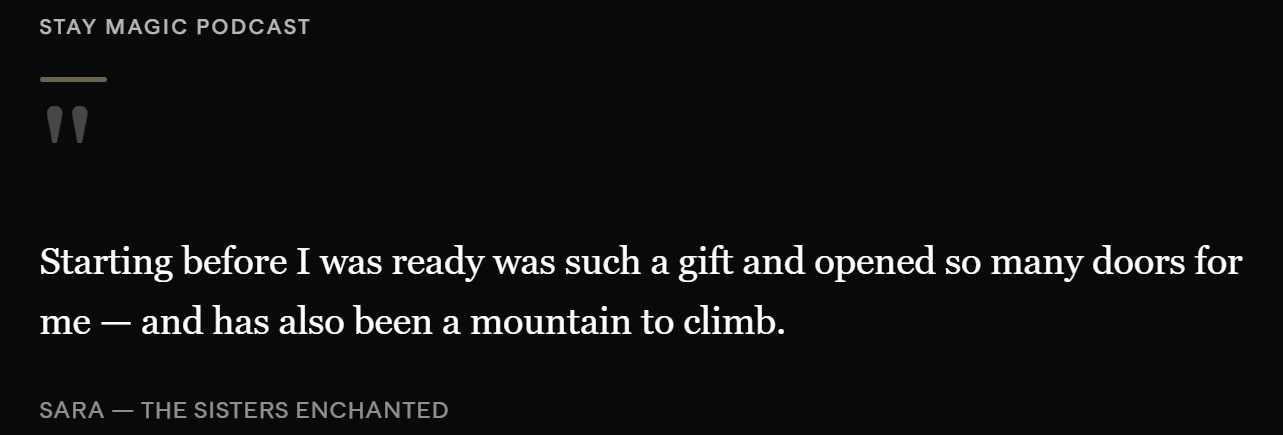
Sara did not start Sisters Enchanted with the confrontation avoidance wound healed. She started with it fully intact, and spent ten years running directly into it in the form of team relationships, customer interactions, and business decisions that required her to hold a line.
That collision is the gift. You will not know which wounds are running you until you are in motion. The starting is what surfaces the wound so you can see it, name it, and actually work with it.
Aries energy, which Sara cites as the energy of this time of year, is not about being fearless. It is about moving despite the fear.
How to Start Healing the Confrontation-Avoidance Witch Wound
These are the shifts that moved the needle most across ten years of Sisters Enchanted:
-
- Notice when you are filling space. After you have said the hard thing and the urge to keep talking arrives, pause. That urge is the wound. You do not have to act on it.
- Ask what is actually true right now. When someone responds to you emotionally, before you react, ask yourself: what is actually happening here, versus what story am I telling about what is happening?
- Repeat yourself calmly without re-explaining. If you have been clear and compassionate and someone responds with pushback, you do not have to justify yourself again. You can simply say the true thing again, just as calmly, just as clearly.
- Let other people have their feelings. Their emotional response comes from their own stories and their own history, not from you. You can be present without being responsible for resolving what they are feeling.
- Remember: not everyone has to like you. That is not failure. That is the reality of being a full person with opinions, boundaries, and a life you are actually living.
Frequently Asked Questions About the Confrontation-Avoidance Witch Wound
What is the confrontation-avoidance witch wound? It is the conditioned pattern of avoiding difficult conversations, smoothing over conflict, and prioritizing other people’s comfort over your own truth. It shows up as over-smiling, over-explaining, and filling silence after a boundary has been held. It is dressed up as kindness, but it is a fear response rooted in old survival programming.
Is confrontation avoidance the same thing as being conflict-averse? They are related, but the witch wound adds a specific layer. Conflict-aversion is a personality tendency. The witch wound is the deeper belief, often ancestral, often cultural, that your power and your willingness to hold a line will make you unsafe. It is not just about wanting peace. It is about fear of what happens when you do not keep it.
How do I know if I am filling silence out of the wound or out of genuine compassion? Ask yourself: am I speaking right now for them, or for me? Genuine care says what needs to be said and holds space for the other person’s experience. The wound fills the space because it cannot tolerate the discomfort of the quiet. If the urge to talk arrives the moment silence does, that is usually the wound, not the compassion.
Does healing the confrontation wound make you less empathetic? No. It makes your empathy more real. When you are no longer using niceness as a strategy to escape discomfort, your presence with other people becomes genuine rather than self-protective. You can actually hold space for what they are feeling rather than rushing to make the difficult feeling go away.
Why does the witch wound show up specifically around confrontation? Because confrontation is visibility. Holding a boundary, saying the hard thing, or disagreeing with someone’s expectations makes you visible. And for women carrying deep witch wound conditioning, visibility has historically registered as dangerous. Staying quiet and keeping everyone comfortable is how you stayed safe. Healing this wound is learning that you can be seen and still be okay.
Do you have to have years of inner work behind you before you start healing this? No. You do not need to have it figured out before you begin. The wound reveals itself in action, not in preparation. As Sara has named throughout ten years of Sisters Enchanted: starting before you are ready is the point. Begin.
The Witch Wound Does Not Have to Win
Ten years. Twelve years of being self-employed. Thousands of women who have come through the Sisters Enchanted community. And the lesson that has mattered most, the one that cost the most and gave the most in return, is this:
You do not have to fill the space.
You are allowed to say the true thing and be quiet. You are allowed to hold your truth while someone else’s reaction is loud. You are allowed to stop managing how your words land in other people’s bodies. Other people’s emotions come from their own stories. That is their work, not yours.
The witch wound wants you to bend, to smile, to over-explain, to keep everyone comfortable enough that no one ever turns on you. But that bending has a cost. It cost Sara. And it will keep costing you until you decide that your truth is worth the discomfort of speaking it and leaving it there.
Happy ten years, Sisters Enchanted. This is just the beginning.
Stay magic, Enchanted Sister.