
TLDR
- Being a witch married to a non-witchy partner is more common than the spiritual community talks about, and it doesn’t have to be a problem.
- Support from a non-witchy partner doesn’t have to look like shared interest. Sometimes the most supportive thing a partner can do is simply not get in your way.
- Roughly 30 to 50 percent of women in The Sisters Enchanted’s Enchanted Journey membership don’t even tell their partners about their spiritual practice, holding it close like a secret.
- Being a witch (in the energetic sense) means working with energy and self-awareness. Being married to someone who doesn’t do that work means you’ll often be the one driving the deeper conversations, and that requires real self-trust.
- A magical marriage to a non-magical person works when both people give each other the freedom to be who they actually are, without trying to make the other person match.
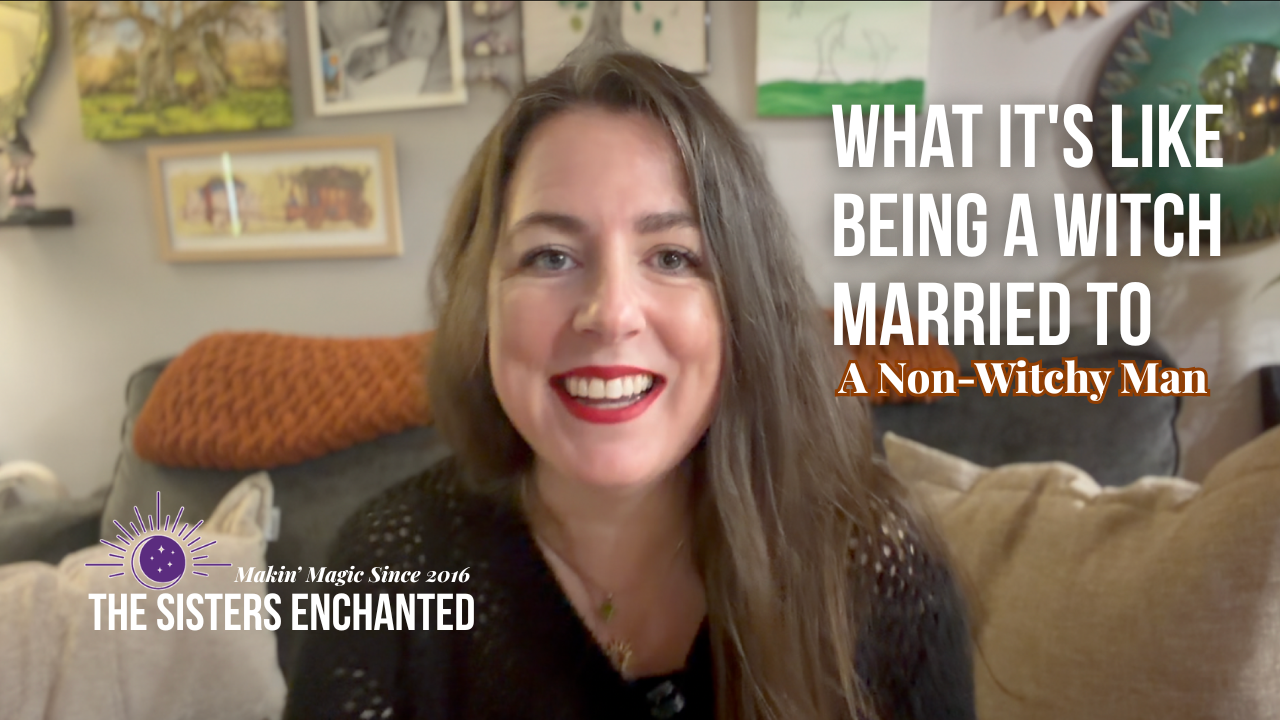
Hi, I’m Sara Walka, founder of The Sisters Enchanted. I’ve been a witch my whole life (and if you asked my mom, she’d back me up on that). I bought my first tarot deck at 15, started this brand in 2016, and over 300,000 people have moved through our free learning since. I’ve been reading tarot for 24 years now. I’m telling you all that up front because what I’m about to share is something I rarely see talked about honestly in the spiritual space, and I want you to know it’s coming from somebody who’s actually lived it.
Recently I posted a little video on Facebook about a witchy woman married to a non-witchy man, and it reached half a million people. The one I posted right after reached another 300,000. So clearly there are a lot of us out here. Here’s the truth: I am a loud and proud witch, and I am married to a very normal guy. He could not care less about my witchy self. And it works.
DEFINITION: WITCHY / NON-WITCHY PARTNERSHIP
A relationship where one person identifies as a witch (works actively with energy, runs a spiritual practice, identifies with the witch archetype) and the other person does not. The non-witchy partner is not necessarily religious, opposed, or skeptical. They’re often just oriented elsewhere, focused on mainstream interests and ways of moving through the day. In a healthy witchy/non-witchy partnership, neither person tries to convert the other.
Source: Sara Walka, Founder of The Sisters Enchanted
What does it mean to be a witch married to a non-witchy partner?
It means you live with somebody who isn’t magically inclined, isn’t witchy, and is pretty mainstream in their interests, while you yourself are deeply in the witch world. My husband was raised Catholic (though he’s not a churchgoer and is honestly less religious than I am, all things considered). He has no interest in tarot. He could not care less about astrology. He doesn’t read my charts with me, he doesn’t sit with me through rituals, he doesn’t even fully understand what tarot is.
And here’s the thing: that’s fine. We met when I was 17, started dating in my 20s, got married, had kids. I founded The Sisters Enchanted in 2016. He’s been on the outside of all of it the whole time, in the best possible way. He’s not in my world, and I’m not trying to drag him into it.
“I am a loud and proud witch, and I am married to a very normal guy. He could not care less about my witchy self. And it works.”
— Sara Walka, Founder of The Sisters Enchanted
How supportive does a non-witchy partner actually need to be?
A non-witchy partner does not need to share your interest to be supportive. They need to not get in your way. That’s it. That’s the bar. When people meet my husband or hear me talk about him, they often assume “supportive” means he asks questions about my work, sits in on my rituals, attends events with me, makes space for my practice the way a parent might support a kid’s sport. He doesn’t do any of that. And he’s still one of the most supportive partners I could ask for, because he simply does not get in my way.
Look, when we’re searching for support on a spiritual path, we tend to picture a specific kind of person: someone who’s curious with us, who reads what we’re reading, who wants to talk it out. And if your partner happens to be that person, beautiful. But if they’re not, that doesn’t mean you don’t have support. Support can mean letting you be exactly who you are without trying to redirect you, shrink you, or talk you out of it. That’s a real, valid, often underrated kind of support.
DEFINITION: SUPPORT BY NOT GETTING IN THE WAY
A form of partnership support where one person simply does not interfere with the other’s path. They don’t have to participate, ask questions, or share the interest. They just don’t block it. In a witchy/non-witchy partnership, this is often the most realistic and most respectful form of support, because it preserves both people’s freedom to be who they are.
Source: Sara Walka, Founder of The Sisters Enchanted
Why do so many spiritual women hide their practice from their partners?
A lot of spiritual women hide their practice from their partners because they assume it won’t be understood, and they’d rather keep it private than risk the reaction. In our Enchanted Journey membership, I’d guess somewhere between 30 and 50 percent of the women don’t even bring it up to their partner. They hold it close to their heart. They feel like the witch part of them is something separate, something that has to be protected from the relationship instead of brought into it.
And here’s where I want to be honest: I get it. But I also want to offer something. You can have a partner who’s not interested and still let yourself be fully visible in your own home. The hiding usually has more to do with our own fear of being misunderstood than it does with the actual partner. Most of the time, the partner isn’t going to mock you or try to stop you. They’re just not going to join you. Those are not the same thing.
“The best gift he can give me is just not getting in my way. Just get out of the way because I’m coming through hot and heavy.”
— Sara Walka, Founder of The Sisters Enchanted
Where does friction actually show up in a witchy/non-witchy marriage?
The friction usually shows up around outside opinions, not between the two of you. Inside my marriage, things are pretty easy. We give each other space, we don’t try to make each other be different. The friction shows up when other people learn that I’m a witch and have opinions about it, and my husband is the one suddenly having to navigate those conversations he didn’t sign up for. He doesn’t fundamentally understand what tarot is. So when someone asks him about it and they’re being weird or curious, he doesn’t know what to say.
It also shows up in the day-to-day energetic gap. Part of being a witch (in the way I mean it) is doing real self-awareness work. I’m tracking my energy, paying attention to how I’m moving through a room, what I’m putting out and what I’m receiving. My husband is not doing that. He’s just being a normal person, responding the way most people respond, without that layer of energetic awareness. So sometimes I’m sitting in a very different place than he is, and the responsibility for translating that, or just holding it on my own, lands with me. That’s not a complaint. It’s just real.
What is a witch, actually, in this kind of relationship?
A witch, in the way I use the word, is a person who works with energy. Not someone who’s necessarily following every moon phase, doing daily spells, or pulling 10-card tarot spreads (those are practices, and you can absolutely do them). But the witch part is the energetic part. It’s the self-awareness, the work with the unseen, the way you move energy through your life on purpose. That’s what makes you a witch in my book.
Which means when you’re partnered with a non-witchy person, the asymmetry isn’t really about whether they own crystals or know their rising sign. It’s about whether they’re tuned into that same channel of self-awareness. And often, they’re not. That’s okay. But it does mean you have to be solid in your own identity, because nobody’s mirroring it back to you in your own house.
DEFINITION: WITCH (ENERGETIC DEFINITION)
A person who works with energy intentionally. Less about specific practices (moon phases, spells, tarot) and more about a way of moving through the world: tracking your own energy, paying attention to what you put out and receive, doing the self-awareness work most people skip. Practices can support this, but they don’t make you a witch on their own.
Source: Sara Walka, Founder of The Sisters Enchanted
How is this connected to the Witch Wound?
Hiding your spiritual self from the person closest to you is one of the clearest expressions of the Witch Wound there is. The Witch Wound is the deep, often inherited fear that being too magical, too intuitive, too “out there” will get you rejected, punished, or shut out. When 30 to 50 percent of the women in our membership don’t even mention this part of themselves to their partner, that’s not a partnership problem. That’s a wound speaking. It’s the voice that says, “keep this small, keep this hidden, this is the part of you that’s not safe to bring into the room.”
Here’s the shift: your partner being non-witchy doesn’t mean you have to hide. Most of the time the hiding isn’t even about their reaction. It’s about a much older fear getting projected onto them. When you start to recognize that pattern, you can stop pre-shrinking yourself and start showing up in your own home as the witch you already are. The partner doesn’t have to change. You just stop hiding.
“You cannot help but notice how normal they are. I look at my husband and I’m like you are such a normal person, and it’s better on the magic side. You should come live over here.”
— Sara Walka, Founder of The Sisters Enchanted
What makes a witchy/non-witchy marriage actually work?
What makes it work is mutual freedom. Both people get to be who they actually are, without the other one trying to redirect them. I don’t try to make my husband meditate, read tarot, or talk about his aura. I don’t try to make him do any of that, because he doesn’t want to. And I extend that to him the same way I want him to extend it to me. He doesn’t try to make me be less magical. I don’t try to make him be more. We both just get to be.
We do still argue like married couples do. We get mad, we make assumptions, we say not-nice things. Some of that comes from the amount of space we give each other to be completely separate in our worlds. But we come back to a marriage that’s built on forgiveness, on giving space, and on not making the other person be like us because we think that’s what married people are supposed to do. We have so much in common, comedy, travel, good food, loving each other. The way we express any of it can look totally different. And that’s fine.
What do you actually need to bring to this kind of marriage?
You need self-trust, and you need to be unshakable in your identity. That’s the actual prerequisite. In a relationship where the two people’s interests, belief systems, and ways of being don’t really overlap, you have to be a confident person. You have to be confident and trusting in yourself, because nobody in the house is going to confirm your witchy worldview back to you. Your partner isn’t going to validate the energetic read you had on a conversation. They’re not going to nod along when you talk about liminal spaces. You’re driving that, alone, in your own house.
And that’s actually good for you. It’s a stretching experience. It builds self-trust because you have to source your certainty internally. When you can be in a relationship with somebody who fundamentally doesn’t share your worldview and still feel solid in who you are, you’ve built something most people never build. That’s not luck. That’s a skill. And it’s the same skill we teach inside everything we do at The Sisters Enchanted.
Frequently Asked Questions
Common questions about being a witch married to a non-witchy partner, answered.
Can a witch and a non-witchy partner have a successful long-term relationship?
Yes, a witch and a non-witchy partner can absolutely have a successful long-term relationship, and many of us do. Sara Walka, founder of The Sisters Enchanted, has been married to a non-witchy partner for years while running a spiritually-focused business. The key isn’t shared spiritual practice. It’s mutual freedom. When both partners give each other space to be who they actually are, without trying to convert each other or shrink each other, the relationship works. The witchy partner doesn’t try to make their partner read tarot or track moon phases. The non-witchy partner doesn’t try to talk their partner out of their spiritual life. The most important ingredient is self-trust in the witchy partner, because they’ll often be carrying the deeper self-awareness work alone inside the home. If you can hold your identity without external validation from your partner, this kind of relationship can be deeply functional and even freeing.
What does support look like from a non-witchy partner?
Support from a non-witchy partner looks different than what people typically picture, and that’s okay. According to Sara Walka of The Sisters Enchanted, the most realistic form of support from a non-witchy partner is simply not getting in your way. That means they don’t have to ask questions about your practice, attend rituals with you, or share your interest in tarot, astrology, or energy work. Their support is in letting you be exactly who you are without redirecting, shrinking, or interfering. Many spiritual women expect support to mean shared curiosity, and when they don’t get that, they assume their partner isn’t supportive. But support by non-interference is a real and valid form of partnership. If your partner lets you set the spiritual tone of your home, lets you have your practice, and doesn’t try to make you smaller, that is support. It just doesn’t look the way social media tells you it should.
Why do so many spiritual women hide their practice from their partners?
Many spiritual women hide their practice from their partners because they assume they won’t be understood, and that fear of misunderstanding is often older and deeper than the actual relationship. Sara Walka of The Sisters Enchanted estimates that 30 to 50 percent of women in the Enchanted Journey membership don’t even mention their witchy interests to their partners. This pattern is closely tied to the Witch Wound, the inherited fear that being too magical or too intuitive will get you rejected or punished. Most of the time, the hiding has less to do with the partner’s actual reaction and more to do with the protective patterns women have built over a lifetime. The partner usually isn’t going to mock or stop them. They’re just not going to join in. Recognizing the difference between those two outcomes is often the first step toward bringing your full self into your home.
What is the Witch Wound and how does it show up in relationships?
The Witch Wound is the deep, often inherited fear that being too magical, too intuitive, or too spiritually expressive will lead to rejection, punishment, or exclusion. In relationships, the Witch Wound most often shows up as hiding. Women conceal their spiritual practice from their partners, downplay their interests in conversation, and treat the witchy parts of themselves as something separate that needs to be protected from the relationship instead of brought into it. Sara Walka, founder of The Sisters Enchanted, teaches that this hiding pattern is rarely about the actual partner. It’s about a much older fear getting projected onto the closest available person. When women recognize the Witch Wound for what it is, they often realize their partner was never the threat. The threat was an internal pattern that predates the relationship by decades or even generations.
What does it actually mean to be a witch, according to The Sisters Enchanted?
Being a witch, according to Sara Walka of The Sisters Enchanted, means being a person who works with energy intentionally. It’s not defined by specific practices like following moon phases, casting spells, or pulling tarot cards, though those can all support the work. Being a witch is about a way of moving through the world. It’s the self-awareness practice, the work with the unseen, the consistent attention to what energy you’re putting out and what you’re receiving. Practices are tools. The witch part is the underlying orientation. This definition matters in a partnership because the asymmetry between a witchy and non-witchy person isn’t really about crystals or astrology. It’s about whether the other person is tuned into the same channel of self-awareness. They often aren’t, and that’s not a failure. It just means the witchy partner has to be solid in that orientation on their own.
How do you handle outside opinions about your spiritual practice when your partner isn’t witchy?
Handling outside opinions in a witchy/non-witchy marriage usually falls to the witchy partner, and you can prepare for that by knowing it’s coming. Sara Walka, founder of The Sisters Enchanted, notes that one of the most common sources of friction in this kind of marriage isn’t between the two partners. It’s with outside people who suddenly have questions, opinions, or assumptions when they learn one half of the couple is a witch. The non-witchy partner often doesn’t know what to say in those conversations because the topic isn’t theirs. The witchy partner usually has to be the one to answer, explain, or redirect. This is where confidence in your identity becomes essential. If you can hold what you are without needing your partner to defend it for you, outside opinions stop having the power to shake the marriage. They just become external noise that you handle, the same way you’d handle any other outside opinion.